A nature camera for kids? Honest answers to the questions parents ask us
For parents who like the idea of Scout but have a question or two first. Every answer is short, and each one links to a longer post if you want the full story.

A nature camera for kids sounds lovely until the sensible questions start. Isn't it just another screen? Couldn't they use my phone? Will it end up in a drawer by the holidays?
Good. Those are the right questions, and we ask them of ourselves all the time. Here are our honest answers, short ones, with a link to a longer post whenever there's more to say.
Isn't this just more screen time?
It has a screen, so we won't pretend otherwise. The question that matters is what the screen is for.
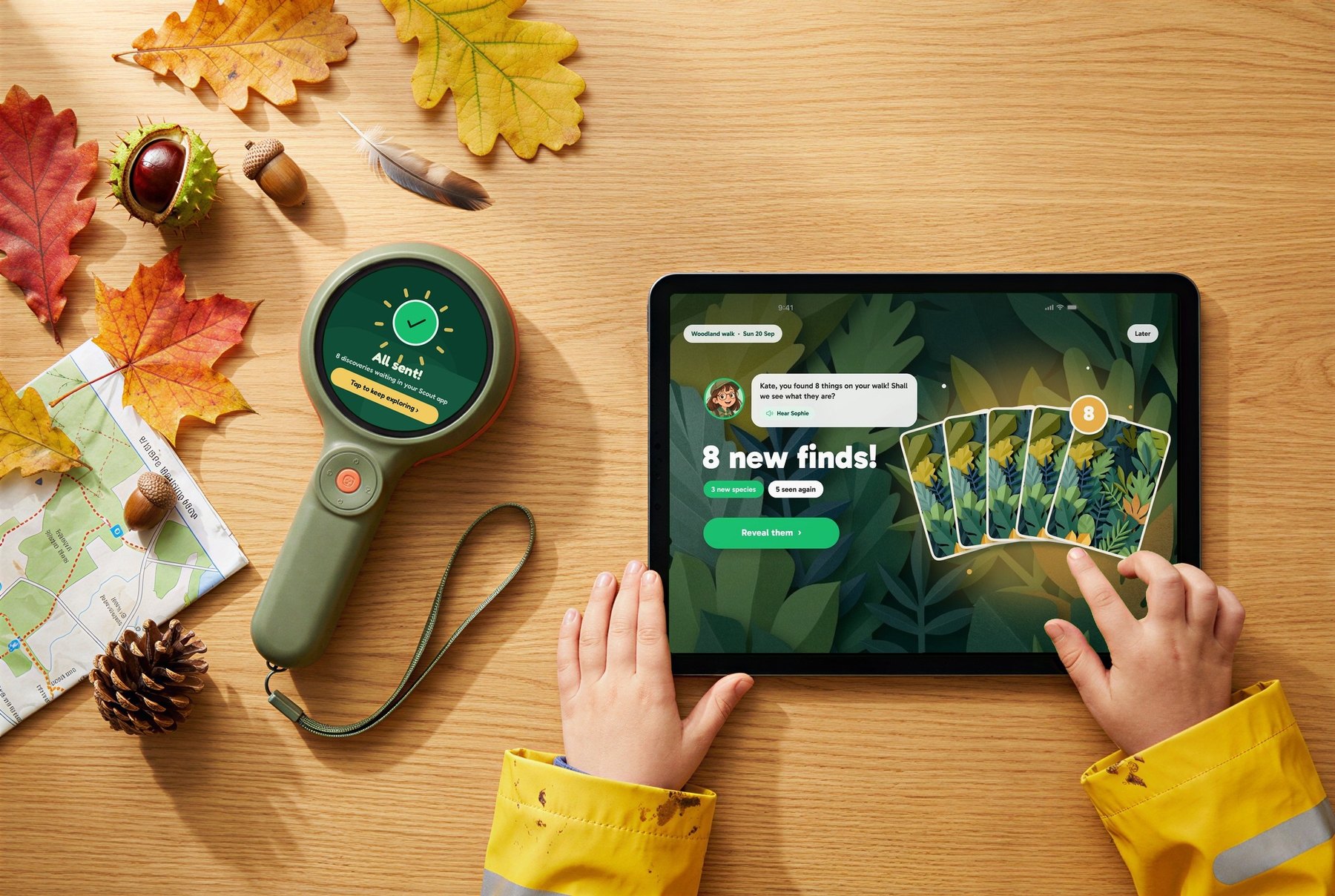
Most screens are built to keep children looking at them. Scout's only job is to help a child look at something else: the beetle, the berry, the bird on the fence. On the walk, the round screen is a viewfinder. The time spent looking at it is time spent outside, pointing at real things.
The UK's Royal College of Paediatrics and Child Health made a useful point when it reviewed the research in 2019: the real worry is screens pushing out sleep, exercise and time together. We built Scout to do the opposite.
The long version: Screen time vs outdoor time for kids: what the research says
There are free nature apps. Why not just use my phone?
Free apps have their place, and they're great for grown-ups. But a borrowed phone comes with everything else on it: messages, notifications, games, and the pull to check something "just for a second". Research on phones in green spaces suggests that pull costs the very attention a walk outside is meant to restore. And whose adventure is it, if the child has to ask for the grown-up's phone every time they spot a spider?
Scout is a camera and nothing else. It has no web browser, no messages and no ads. It's the child's own, on their own wrist, and your phone stays in your pocket. And it's made for their hands: shaped like an explorer's magnifying glass, with a grippy handle and every button under the thumb, so it works one-handed.
The long version: A free nature identification app for kids, or a camera of their own?
My child isn't really into nature. Will they lose interest after a week?
Maybe, if it's pitched as a lesson. Children who "aren't into nature" are often very into collecting, games, challenges, gross things and being the first to find something. That's the door in.
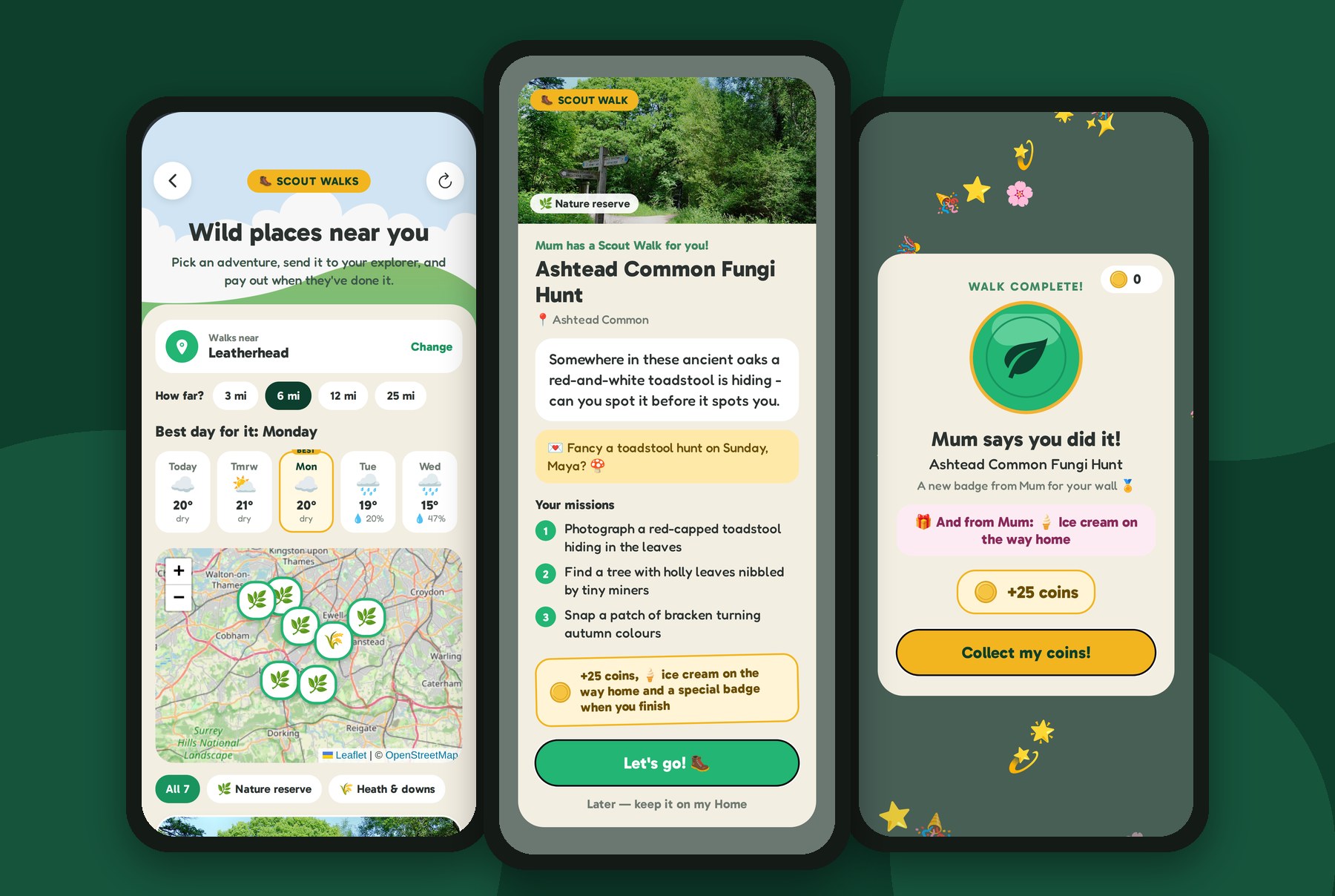
Scout leans into all of it. Every new find becomes a card in their collection, and badges, challenges and a map of the places they've explored grow from real walks. The seasons change what's out there, so the next walk is never quite the same as the last. No gadget will make a child love nature on its own, but it can make the first few walks a lot more fun.
The long version: How to get kids interested in nature
I don't know the names of anything. Can I still help?
Yes, and you might be the best person to. Knowing a name is the smallest part of it. Noticing, wondering and finding out together is the real thing, and "I don't know, let's find out" is exactly how scientists work.
On the walk, your child's guide names what they've found right there, using Scout's own AI chip, and only when it's sure. Back home, every new find becomes a Discovery Card with facts the guide reads aloud, so you'll both learn something.
The long version: You don't need to be an expert to explore nature with kids
What if it gets something wrong?
It would rather say "I'm not sure" than tell your child something wrong. The guide only names a group when it's right at least 85 times in 100, and when it isn't that sure it says so, or steps back to something broader, like "some kind of thrush" or "a bird".
Back home, the careful answer works the same way: the exact species when it's confident, otherwise the wider group. A find it can't place becomes a Mystery, waiting for a clearer photo. And if you ever spot a fact on a card that's wrong, tell us and we'll fix it for every family.
A good photo makes a big difference, especially with plants. Photograph the flower, the berries or one clear leaf, not a whole hedge.
The long version: How Scout knows what it's looking at and How to photograph plants for identification
Where do the photos go? What about faces?
Back home, your phone checks every photo for faces before anything is sent. A photo with a face in it stays on your family's own devices as a memory, and is never sent to us. Only nature photos go to our own servers to be named, and the server uses the photo's location only to look up what lives nearby, without keeping the exact spot.
We ask for your child's first name and an age band, nothing more. No ads, no leaderboards, and coins are earned by exploring, never bought.
The long version: Kids camera privacy: what really happens to your child's Scout photos
Is there a subscription?
You don't need one. The camera, the guides, the cards, the badges and the app all work without it, and the guides answer a set of ready-made questions on every card for free.
An optional Scout Pro plan adds extras for families who want them, such as asking the guides anything, as often as you like. We'll explain exactly what's in it before the Kickstarter goes live.
What do we need at home?
Home Wi-Fi and the free Scout app on a phone, tablet or computer. That's where the reveal happens and the collection lives: after the walk, not during it.
We live in a city. Is there enough to find?
Plenty. Sidewalk cracks, walls, street trees, parks, canals and yards are full of life, and a lot of it is easy to photograph because it can't run away. City walks are often the easiest ones to fit into a school week.
The long version: Urban nature walk with kids: how to find wildlife in the city
Who is it for, and is it a toy?
Curious kids aged 9 to 13, and the grown-ups who explore with them. It's a real camera, designed as a proper instrument for looking closely, not a toy.
When can we get one?
Scout is launching on Kickstarter in spring 2027. Families on the waitlist hear first, the moment the campaign goes live. With Kickstarter, you pledge, your card is charged only if the campaign reaches its funding goal, and Scouts ship to backers once the first production run is made.
The long version: How does Kickstarter work? How to back Scout, step by step
Still got a question?
Reply to any of our emails and ask. We read every one, and the best questions end up on this page.