Urban nature walk with kids: how to find wildlife in the city
For families who live in towns and cities and want to find nature without a drive to the countryside. You'll get a ready-made walk, what to look for and a few games to play on the way.
You don't need a forest for a proper nature walk. Cities are full of wildlife, and much of it is hiding in plain sight: in cracks, on walls, up on rooftops and in the park down the road. An urban nature walk with kids is also one of the easiest to start, because you can do it on the way to school or the shops. This guide gives you what to look for, from the smallest plant to the fastest animal on Earth, plus games that turn any street into an expedition.
What can you find on an urban nature walk?
More than you'd guess. On a single street you might find:
- plants growing in sidewalk cracks and up walls;
- lichens on trees, walls and gravestones;
- pigeons, gulls and crows with very city-smart habits;
- street trees from all over the world;
- mammals that come out at dusk, from raccoons to coyotes.
Pick one or two of the sections below for each walk. Going slowly is the whole point.
Start with a crack safari
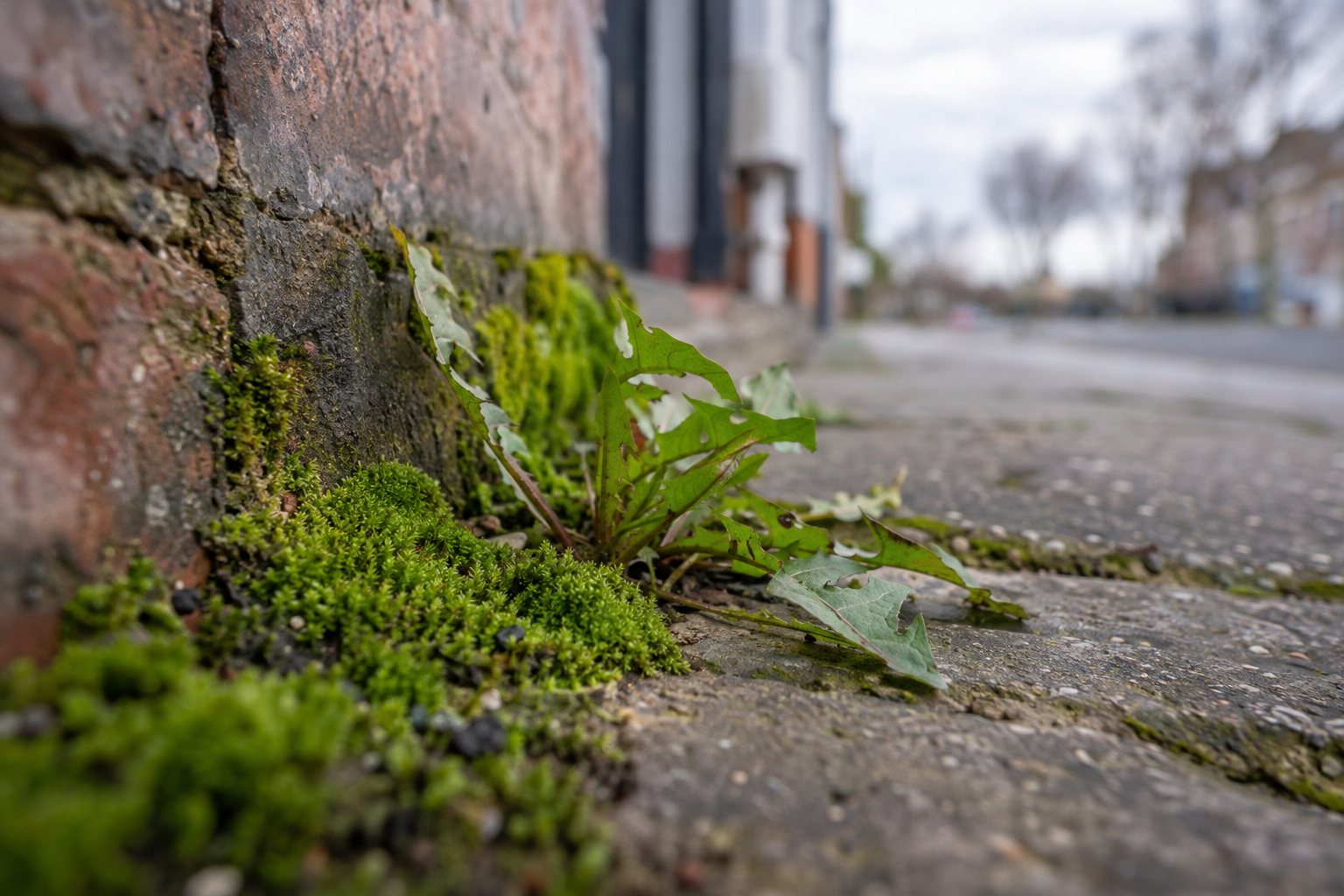
A crack safari is exactly what it sounds like: walk slowly, look down and see how many different plants you can find growing in the cracks.
Why do plants grow there? Seeds blow in on the wind or ride in on shoes and paws. A crack collects a little soil and rainwater, the stone around it holds the day's warmth, and there's hardly any competition.
Plants you'll often meet:
- Dandelion, with its flat rosette of toothy leaves.
- Broadleaf plantain, with wide leaves and ribbed veins running lengthways.
- Purslane, a juicy-leaved creeper with reddish stems.
- Crabgrass, spreading out in a flat star.
- Prostrate knotweed, a wiry mat with tiny leaves that loves trampled ground.
- Common chickweed, with small white star-shaped flowers.
Game: count the different kinds of plant in 50 steps, then try a different street and compare. Take a photo or a sketch of each rather than picking them.
Crack safari rules: stay on the sidewalk side away from the road, don't eat or taste anything, avoid dog mess, and wash your hands afterwards.
What can lichens tell you about city air?
Those crusty gray, green and orange patches on trees and walls are lichens. A lichen isn't one living thing but two working together: a fungus and a partner (an alga or a type of bacteria) that makes food from sunlight.
Lichens soak up whatever is in the air, which makes them useful clues:
- In the past, smoke from coal filled city air with a gas called sulfur dioxide, and most lichens couldn't survive in the middle of cities. As the air got cleaner, many came back.
- Today a big one is nitrogen pollution, from traffic fumes and farming. Some lichens, like the bright orange-yellow Xanthoria and some gray leafy kinds, actually do well where there's extra nitrogen.
- Bushy, beard-like lichens that dangle from twigs usually need cleaner air.
So a tree by a busy road covered in orange lichen, and a tree in a quiet park with bushy lichen on its twigs, are telling you slightly different stories. It's a clue, not a measurement, and scientists use proper surveys to be sure.
Look on tree trunks, twigs, old walls and gravestones. Please don't scrape lichens off: many grow extremely slowly.
Which city birds have city habits?
Pigeons. City pigeons are descended from the rock dove, a wild bird that nests on sea cliffs. To a pigeon, a building is a cliff with extra ledges. Watch one walk: its head seems to bob, but it's really holding its head still while its body catches up. That keeps its view steady, like a camera on a stand.
Gulls. On wet grass in parks, you might see a gull stamping its feet as if dancing. It's called foot-paddling. The patter brings worms up to the surface, and the gull gobbles them.
Peregrine falcons. The fastest animal on Earth nests on city buildings in both countries: cathedrals, tower blocks, bridges and skyscrapers. In a hunting dive a peregrine can reach more than 185 miles an hour. Look high up on tall buildings for a stocky, slate-gray bird with a pale chest. A scatter of pigeon feathers below a ledge is a clue. Many city peregrine nests have webcams you can watch at home.
Which mammals live in the city?
- Raccoons. Clever, nimble-handed and mostly out at night. Look for their hand-like footprints in mud or snow.
- Squirrels. Gray squirrels and bigger, orange-bellied fox squirrels are park regulars. Watch one bury a nut. Squirrels bury food in lots of places and forget some, and a few of those nuts grow into trees.
- Coyotes. They now live in many American cities. Scientists studying them estimate that around 2,000 coyotes live in the Chicago area alone, and they have been tracked right in the middle of the city.
The golden rule for city animals: watch from a distance, never feed them, and never try to touch them. If a coyote comes toward you, don't run: stand tall with your grown-up, make some noise and back away slowly.
What's growing along the street?
Street trees are chosen because they can cope with tough city life. Many come from far away. A great one to know in both countries is the London plane: it's one of London's best-known street trees and the most common street tree in New York City. Spot it by its patchwork bark, peeling off in pieces to leave cream, green and gray patches like camouflage, and its spiky round seed balls that hang on through winter.
Games for street trees:
- Adopt one tree on your route and check it every month.
- Make a bark rubbing with paper and a crayon.
- Find the widest trunk on your walk and see how many arms it takes to hug it.
Some cities, New York among them, publish maps of their street trees online, so you can look up the name of the one outside your door.
Where are the wildest places in a city?
- Parks with ponds bring in ducks, geese, herons and dragonflies in summer.
- Canals and rivers are wildlife highways through the city.
- Old cemeteries are often some of the wildest places in town, with big old trees, ivy, lichens and quiet corners birds love. Mount Auburn Cemetery near Boston is famous with birdwatchers for the warblers that stop there in spring. Visit respectfully: quiet voices, stay on paths and never climb on graves.
Staying safe on a city nature walk
- Stay with your grown-up, and stop well back from the road before you look down or up.
- Wash your hands after touching plants, soil or walls.
- Don't touch droppings, dead animals or litter.
- Never eat or taste wild plants.
- Leave nests and animals alone.
Your city is wilder than you think
The best thing about an urban nature walk is that you can do it again tomorrow and find something new. Scout, the nature camera we're making for 9 to 13s, is built for walks like this: when a child points it at something alive, their guide names it right there on the walk, using Scout's own AI chip. And it would rather say "I'm not sure" than guess, which is exactly the right attitude on a crack safari.
Sources
- NHM: Nature and pollution: what lichens tell us about toxic air
- Imperial College London: OPAL Air Survey
- Positive News: More than weeds: the rebel botanists on a mission to celebrate urban plants
- Journal of Experimental Biology: Head bobbing gives pigeons a sense of perspective
- The Wildlife Trusts: Rock dove
- British Birds: Foot-paddling in gulls
- Britannica: Peregrine falcon
- Natural History Museum: Peregrine falcons are the top birds in town and The secret life of urban foxes
- Wildlife Online: The grey squirrel in Britain
- Urban Coyote Research Program: How many coyotes are in Chicago? and About the project
- NYC Parks: The top five most common street trees in NYC
- Hackney Council: Abney Park Cemetery
- Mount Auburn Cemetery: Birds and birding