Things to do outside in the rain with kids: a rainy-day nature walk
For parents who'd rather not spend a wet weekend indoors. You'll get what's worth looking for in the rain, simple experiments, what to wear and the safety basics.
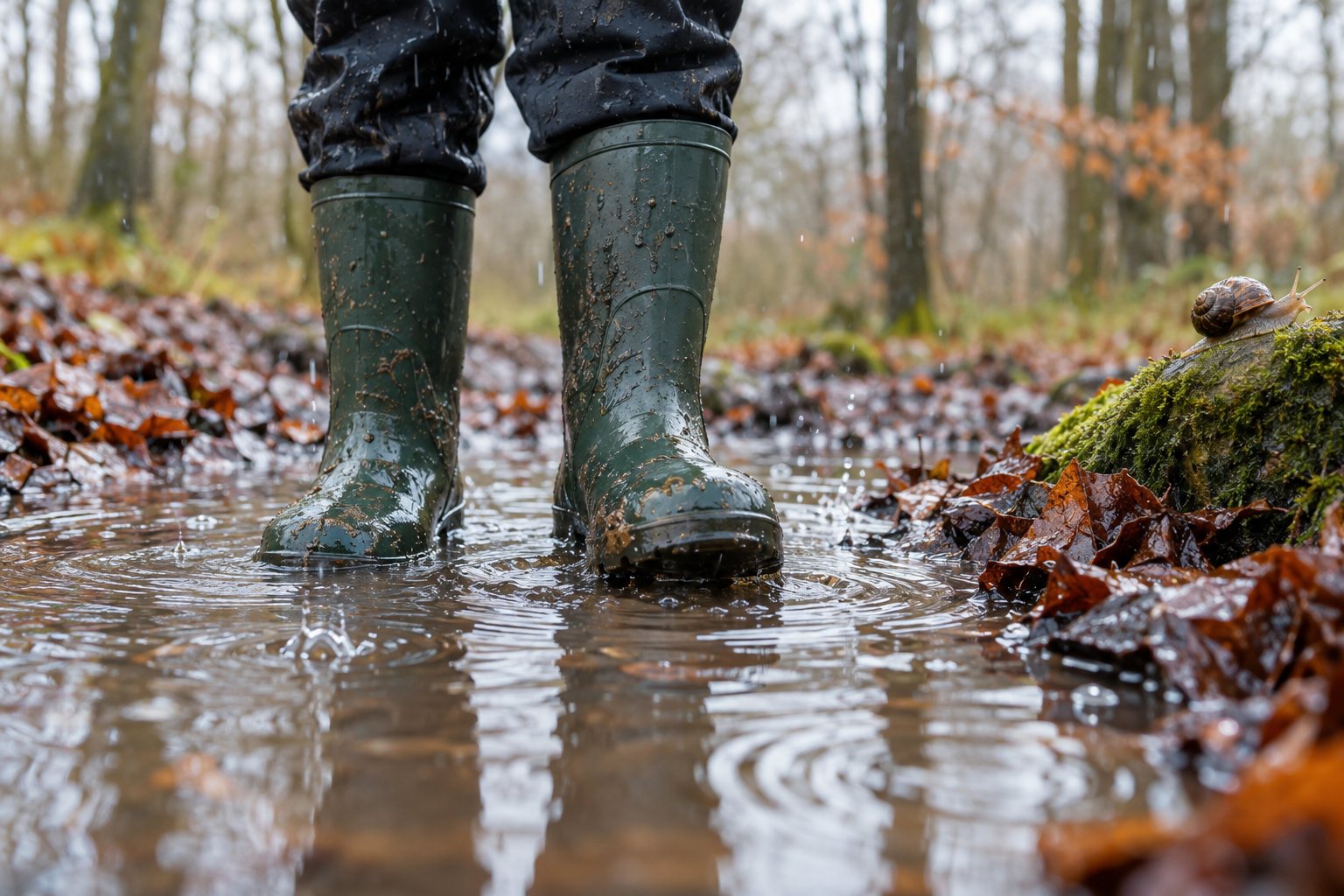
Rain doesn't cancel a nature walk. It changes the cast. Snails come out to explore, worms appear on the paths, frogs and toads get moving, and a few days later the fungi pop up. If you've been looking for things to do outside in the rain with kids, the good news is that the best of them need nothing more than the right boots.
Here's what to wear, what to look for, some puddle science to try, how to build a rain gauge, the story behind the smell of rain, and how to stay safe when the weather turns.
What to wear (so it's fun, not miserable)
A rainy walk is only as good as the kit. Children get cold faster than adults, especially when they're wet.
- Wellies with warm socks, and a spare pair of socks in your bag.
- A waterproof jacket with a hood, and waterproof trousers if you have them. Puddles splash up.
- Warm layers underneath, like a fleece or jumper. In November, add a hat and gloves.
- A clear plastic bag for a phone or camera, so you can still take photos.
- Towels and dry clothes waiting at home, and something warm to drink. It's the part children remember.
What comes out when it rains
Snails and slugs
Slugs and snails need moisture to move, so in dry weather they hide away under stones, logs and leaves. Rain brings them out. Try a slug and snail count along one wall or fence, and look at snail shells closely: most spiral the same way. See if you can find one that turns the other way. They're rare.
Earthworms
After heavy rain, worms appear on paths, lawns and pavements. The honest answer to "why?" is that scientists aren't completely sure, which makes it a great question to talk about.
The old explanation was that worms come up to avoid drowning. That's now doubted: worms breathe through their skin, and experiments have shown some can survive for weeks in waterlogged soil. The main ideas today are:
- Travel. Wet ground lets worms move quickly across the surface to find food, new places to live or a mate, much faster than burrowing.
- Vibrations. Drumming rain may feel like a digging mole, one of their main hunters, so they head up and away.
Watch the lawn after rain and you'll see who else knows about the worms: blackbirds and song thrushes, standing still, head tilted, then pouncing.
Frogs and toads
In November, frogs and toads are looking for somewhere to spend the winter, such as leaf piles, compost heaps, log piles and soft soil. On a mild, wet evening you may meet one on the move. Admire it where it is, and don't pick it up: their skin is delicate and absorbs whatever is on your hands.
The really big amphibian event comes after winter. From late January to March, on mild, damp evenings, toads walk back to the ponds where they were born, and volunteer "toad patrols" help them across busy roads. Froglife's Toads on Roads project can tell you if there's a crossing near you.
Fungi
Rain is what fungi have been waiting for. A few days after a good soaking, look for new caps on lawns, logs and the woodland floor. Our guide to fungi hunting with kids covers what to notice and the safety rules. The short version: look and photograph, never pick or eat.
Webs full of raindrops
Spider webs you'd never notice on a dry day turn into strings of beads in the rain. Count how many you can find along one hedge or fence line.
Puddle science
Puddles are free science labs. A few experiments to try:
- The shrinking puddle. Draw round a puddle on a path or pavement with chalk. Come back in an hour, then the next day, and draw round it again. Where did the water go? Some soaked into the ground, and some evaporated into the air.
- Ripple watch. Look at the rings each raindrop makes. Do big drops make bigger rings? What happens when two sets of rings meet?
- Float or sink. Before you try each one, guess: will a leaf, a twig, an acorn or a pebble float? Put everything back where you found it afterwards.
- Follow the water. Pick a trickle and follow it downhill. Where does it go? A drain, a ditch, a stream?
- Puddle jar. Scoop some muddy puddle water into a clear jar, put the lid on and leave it on a windowsill overnight. By morning it will have settled into layers. Wash hands afterwards.
Make your own rain gauge
A rain gauge tells you exactly how much rain fell, and it's easy to make:
- A grown-up cuts the top off a clear plastic bottle with straight sides, where the curve starts.
- Put a few pebbles in the bottom so it doesn't blow over, then pour in water until it's level with the start of the straight sides. That's your zero.
- Stick a strip of tape up the side and mark a scale on it with a ruler, in millimetres.
- Turn the cut-off top upside down and push it into the bottle as a funnel.
- Stand it outside, in the open and away from trees and buildings.
- Check it at the same time every day, write down the reading, then tip out the rain back to your zero line.
Keep a week's readings, then compare them with the official figures for your area from the Met Office.
The smell of rain
That fresh, earthy smell when rain hits dry ground has a name: petrichor. It was named in 1964 by two Australian scientists, Isabel Joy Bear and Richard Thomas, who worked out that oils collect on dry rocks and soil and are released when the rain arrives. The word comes from Greek: petra, stone, and ichor, the fluid said to flow in the veins of the gods.
The earthy part of the smell has its own name too: geosmin, made by bacteria that live in soil. Human noses are astonishingly good at detecting it, at just a few parts per trillion. In 2020, scientists in Sweden and at the UK's John Innes Centre found that geosmin attracts springtails, tiny soil animals that eat the bacteria and carry their spores away. So the smell of rain may really be an advert, just not one meant for us.
Try it: sniff the soil on a dry day, then again just after a shower. The smell is usually strongest when rain falls after a long dry spell.
Staying safe in wet weather
- Thunder means go inside. If you can hear thunder, you're close enough to be struck by lightning. Head for a building or a car, and don't shelter under trees. The Met Office's advice is to find a safe, enclosed shelter.
- Keep out of floodwater and fast streams. Just 15 cm of fast-moving water can knock an adult off their feet, and floodwater can hide open drains, sharp objects and dirty water. Adults decide about water, every time.
- Watch your step. Wet leaves, rocks, roots and wooden boardwalks are slippery.
- Be seen. Rain makes it harder for drivers to see you, so wear something bright near roads.
- Go home before anyone's shivering. Cold and wet together can chill a child quickly.
- Wash hands after puddles, mud and worms.
Taking it further
A wet walk makes a great page for a nature journal: the rain gauge reading, the snail count, a photo of a web full of drops. That's the kind of record Scout is built for. Scout is a nature camera for kids aged 9 to 13, shaped like an explorer's magnifying glass and worked with one thumb, launching on Kickstarter in spring 2027, and back home every new find becomes a Discovery Card in the free Scout app, with a map of the places they explored.
Rain is an invitation
Most people stay in when it rains, which means you'll often have the park to yourselves. Put the boots on, go for twenty minutes, and see what's come out to meet you. Then come home, get dry, and have that hot drink.
Sources
- Earthworm Society of Britain: Why do earthworms come out when it rains?
- Scientific American: Why do earthworms surface after rain?
- Froglife: Toads on Roads
- Froglife: Autumn advice for amphibians and reptiles
- Mass Audubon: Big Night, amphibian migrations
- Met Office: Make your own rain gauge
- CSIRO: The smell of rain, how our scientists invented a new word
- John Innes Centre: Research unearths the science behind the smell of spring
- Becher et al. (2020), Nature Microbiology: geosmin attracts springtails to Streptomyces
- John Innes Centre: Meet the molecules, geosmin
- Met Office: Stay safe in thunder and lightning
- National Weather Service: Lightning safety
- National Weather Service: Turn Around Don't Drown