Night walk with kids: bats, moths, owls and glowing eyes to find after dark
For parents who want a short adventure after dark with a curious 9 to 13-year-old. You'll get what to bring, what's out at this time of year, the tricks that help you see, and the safety basics.
The same path you walk every weekend is a different place after dark. Owls call, bats flick past, slugs glide out and moths come to the light. A night walk with kids doesn't need to be long or far: half an hour round the block, the park or your own garden is plenty.
This guide covers what to bring, how to help your eyes see, what's out at this time of year (and what to save for summer), and how to stay safe.
Before you go: kit and safety
Plan it like any walk, with a few extras for the dark:
- Go with a grown-up, always, and take a route you already know from daylight. Paths you know are paths you won't get lost on.
- Stay well back from water. Ponds, rivers and canal edges are harder to see at night.
- Bring a torch each, ideally with a red-light setting (more on why below), plus one bright white one and spare batteries.
- Wear something light-coloured or reflective if you'll be near any road, and warm layers, because evenings cool quickly.
- Take a charged phone and tell someone at home where you're going.
- Watch, don't touch. Night animals are easily scared, and some, like bats, should never be handled.
Dark evenings are about to arrive early. The clocks go back on Sunday 25 October 2026, so by late October it's dark around teatime, which makes a night walk easy to fit in before bed.
Help your eyes see in the dark
Your eyes need time to switch to night mode. It takes roughly 20 to 30 minutes in the dark for them to reach full sensitivity, and a few seconds of bright white light can undo it.
That's where red light comes in. The cells that do most of your night seeing are much less sensitive to red, so a dim red torch lets you check the path without wiping out your night vision. If yours has no red setting, stretch a red balloon or a few layers of red cellophane over the end.
Try this: stand still, switch everything off, and count how many more stars or shapes you can see after five minutes, then after fifteen.
Bats
When: from dusk, on mild, dry evenings. Bats are busiest from spring to late summer, when there are the most insects to eat.
In the UK, all bats hibernate from around November to March, and they start slowing down in October. On a mild late-October evening you may still catch one; on a cold one, they'll probably stay tucked away. The common pipistrelle is small enough to fit in a matchbox, yet it can eat 3,000 insects in a night.
Where: along lines of trees and hedges, over ponds and rivers, and around streetlights, where insects gather. Look for a fast, flickering flight against the sky just after sunset.
Most bat calls are too high-pitched for us to hear. A bat detector turns them into clicks you can hear, and local bat groups often run guided bat walks with detectors to borrow. Never touch a bat, even one on the ground. If you find one, keep children and pets away and call the Bat Conservation Trust's helpline for advice.
Owls
You'll hear owls long before you see them, and autumn is a noisy time for them as they claim and defend territories.
The famous "twit-twoo" is actually two tawny owls talking: the female calls a sharp "ke-wick", and the male answers with a wavering "hoo-hoo-oo". Tawny owls call most on autumn evenings, so late October is a great time to listen. If you're near open fields, you might see a barn owl's ghostly white shape gliding low.
Stand still together, stay quiet for two minutes and just listen. Please don't play owl calls from a phone to attract them: it can disturb real owls on their own territory.
Moths and the moth sheet
For every kind of butterfly there are dozens of kinds of moth. The UK has around 2,500 species of moth, and only 59 species of butterfly seen regularly. Most fly at night, and many are far more beautiful than their reputation.
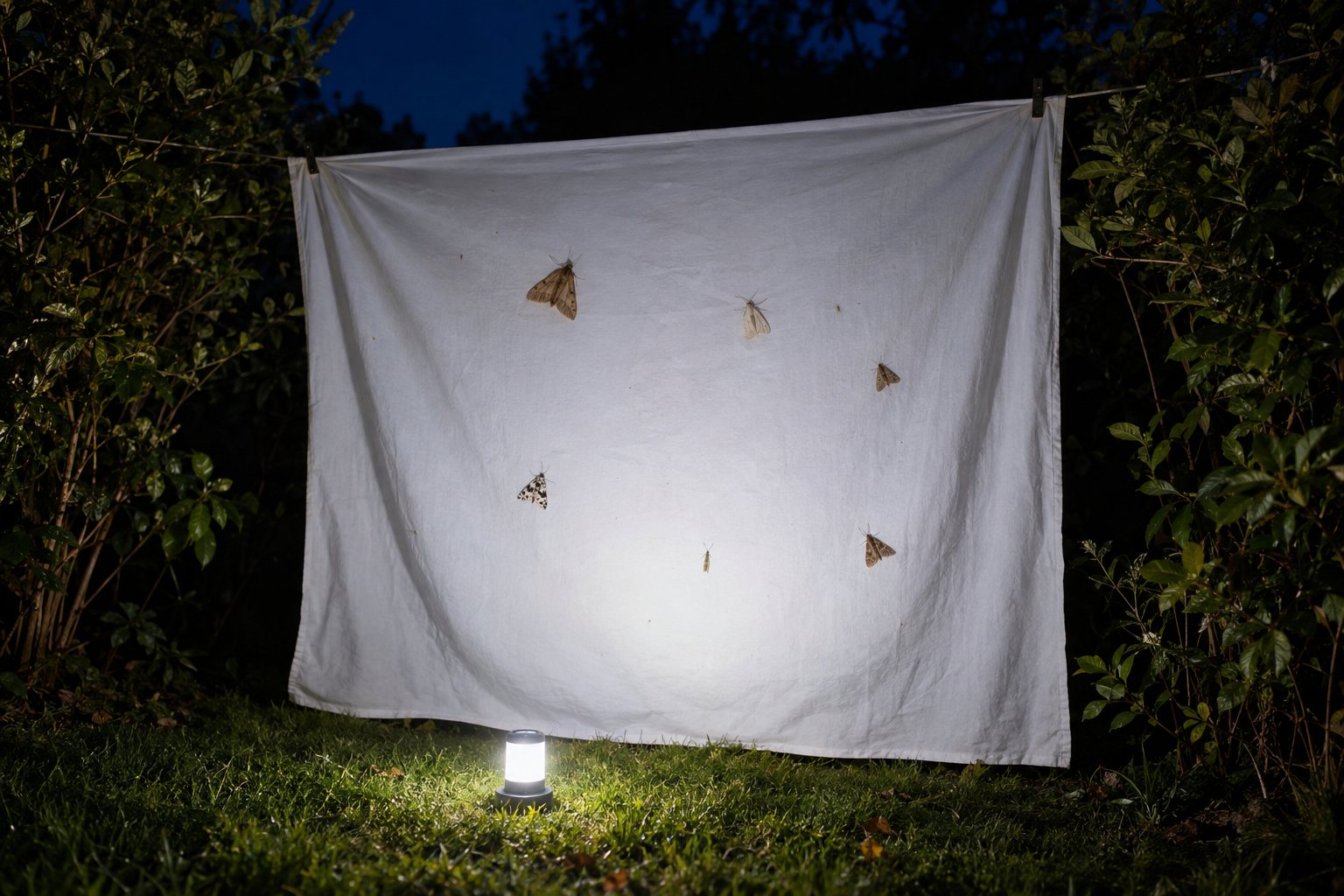
You can bring them to you with a moth sheet:
- Hang a white sheet over a washing line or fence, or between two branches.
- Shine a lantern or bright torch onto it, or set the light on the ground just in front.
- Wait 20 minutes, then look closely at what has landed. Count them, photograph them, and see how many different patterns you can find.
- Switch the light off when you're done, and let the moths go on their way.
Moths fly best on warm, still, cloudy nights, so a summer evening brings the most. But they don't stop in autumn. Some even have month names, like the November moth and the December moth, because that's when they fly.
Slugs, snails and worms
On damp nights, look down. Slugs and snails glide out along paths, walls and fences, leaving silvery trails you can follow with your torch. Earthworms stretch across wet lawns, and sometimes you'll catch one half out of its hole.
Shine your light low and see who's out: a big spotted slug, a snail with its eye-stalks up, a worm pulling a leaf into the ground. Look closely but leave them where they are, and wash hands if anyone does touch one.
Glowing things: what to find now, and what to save for summer
Glowing eyes (any time). Wear a head torch or hold a bright white torch right beside your eyes, and sweep it slowly across a lawn or leaf litter. Tiny green sparkles shining back are often spiders' eyes: wolf spiders in particular have eyes that reflect light, like a cat's. Walk up slowly and see who's looking at you.
Glow-worms (summer). Glow-worms are beetles, and it's the flightless females that glow, climbing grass stems and shining a greenish light to attract a mate. Look in June and July, in grassy places well away from streetlights, once it's properly dark. You won't see them in October, so put a date in the diary for next summer.
Look up: stars and shooting stars
On a clear night, find the Plough, the saucepan shape of seven bright stars. The two stars on the side of the "pan" farthest from the handle point to the North Star. Once you can find it, you'll always know which way is north.
Timing is on your side this week. The Orionid meteor shower peaks around 21 to 22 October 2026. The best show is in the early hours before dawn, which is too late for most families, but a clear evening walk might still catch a shooting star or two if you're patient and your eyes have adjusted.
Taking it further
If your child keeps a nature journal, the night walk deserves its own page: what you heard, what came to the sheet, and how dark it really was. That's the idea behind Scout, a nature camera for kids aged 9 to 13, shaped like an explorer's magnifying glass and worked with one thumb that's launching on Kickstarter in spring 2027. Back home, the photos go to the free Scout app, where every new find becomes a Discovery Card and a nature journal grows from real walks.
One last thing: go slowly
The secret of a good night walk is doing less. Walk slowly, stop often, switch your lights off and listen. Ten minutes of standing in the dark together, hearing an owl you can't see, is the kind of thing children remember for years.
Sources
- Bat Conservation Trust: hibernation of pipistrelle bats
- National Trust: Our guide to UK bats
- The Wildlife Trusts: Common pipistrelle
- Three Rivers Park District: How bats survive Minnesota winters
- New Hampshire Fish and Game: Bats of New Hampshire
- Woodland Trust: How to identify UK owl calls
- Butterfly Conservation: Moths
- The Wildlife Trusts: Glow-worm
- Great Smoky Mountains firefly season (My Smoky Mountain Park)
- IFLScience: Wolf spider eyes shine in torchlight
- Royal Observatory Greenwich: Orionid meteor shower 2026
- EarthSky: Orionid meteor shower 2026