Why a camera of their own beats a nature identification app for kids on your phone
For parents wondering whether a free app on their own phone is enough for a curious child. You'll get the research on phones, attention and time outside, and why a child's own nature camera changes the walk.
"Why would my child need their own device? There are free apps. They could just use my phone." It's a fair question, and we hear it a lot. A good nature identification app for kids costs nothing, and you already carry a phone. This post makes the case, with the research to back it, for why a child's own nature camera gives them something a free app on a grown-up's phone can't.
First, credit where it's due. Free apps such as Seek by iNaturalist and Merlin Bird ID from the Cornell Lab of Ornithology are clever, carefully made and genuinely useful. For a keen grown-up, or for a family's very first taste of naming what they find, they're great. But what matters on a walk isn't only the identification. It's everything else that comes along with the phone.
Whose adventure is it?
Picture the walk. Your child spots a spider on a web and shouts. Then they wait while you find your phone, unlock it, open the app and hold it up. Maybe they get a turn at pressing the button. Maybe you're in the middle of a message and say "hang on".
None of that is bad parenting. It's just how a borrowed tool works: whoever owns it leads. The child becomes the passenger on their own discovery.
With a camera of their own, that flips. They spot it, they point, they press, and they decide what's worth a closer look. It's their button and their adventure, not a turn on a grown-up's phone. For a 9- to 13-year-old, who is itching to do things for themselves, that shift from asking to doing is huge.
What does a phone bring on the walk?
A phone is an amazing object. That's exactly the problem outdoors. Next to the nature app sit messages, games, video, a web browser and a steady stream of little buzzes asking to be checked "just for a second".
That stream is bigger than most of us realise. In Common Sense Media's Constant Companion study, researchers tracked the phones of about 200 young people aged 11 to 17 for a week. The typical participant got 237 notifications a day. About a quarter arrived during the school day, and 5% at night.
And you don't even have to answer a notification for it to cost you. In a 2015 lab study, Cary Stothart and colleagues gave volunteers a task that needed steady attention, then sent calls or texts to their phones while they worked. The volunteers didn't pick up, but they still made more mistakes. The buzz alone was enough to pull their minds away, and the researchers said the effect was comparable to what earlier studies had found for people actively using a phone.
Here's the part that matters most for a walk. In a 2019 study called "How to waste a break", Bin Jiang, Rose Schmillen and William Sullivan gave 81 people a demanding attention test (remembering strings of numbers), then sent them on a 15-minute break, either in a leafy green space or a barren, concrete one, some with a laptop and some without. Time in the green space boosted people's attention, but using the device there cancelled out much of that boost. The device in that study was a laptop, but the researchers' conclusion was about portable devices in general: to get the benefit of a green space, you have to put the device aside.
A nature camera that only does one job has nothing to put aside. There's no browser, no messages, no ads and no app store. No notifications, nothing to tempt, and nothing to police.
Why not just give them their own phone?
Many families get here eventually. But it's a much bigger step than it sounds, because a smartphone opens the door to the whole internet, not just to the nature app.
It's also happening early. Ofcom's 2026 look at UK children's media lives found that smartphone ownership jumps from 56% of 10-year-olds to 83% of 11-year-olds, with starting secondary school the tipping point for many.
And lots of parents are pushing back. Smartphone Free Childhood, started by two parents in 2024, asks families to sign a Parent Pact: no smartphone until at least 14, and no social media until 16. Well over 150,000 families have signed it, and there are similar movements in the US, such as Wait Until 8th.
If your family is choosing to wait, a dedicated nature camera lets your child explore, collect and learn on their own terms, without opening that door before you're ready.
Your phone stays in your pocket
This one's about us grown-ups. In a 2020 Pew Research Center survey of 3,640 US parents, 68% said they're at least sometimes distracted by their phone when spending time with their children.
That distraction matters. In one field experiment, more than 300 people shared a meal with friends or family at a restaurant, and were randomly asked either to keep their phones on the table or to put them away. With phones out, people felt more distracted and enjoyed the time together less. Another study, of 170 US families with young children, found that families where parents reported more "technoference", meaning tech interrupting time with their child, also tended to report more behaviour problems in their children. That's a link, not proof that one caused the other, but it's a pattern worth noticing.
On a walk, a shared phone soon becomes the centre of things: two heads bent over one screen. When the child has their own camera, your phone stays in your pocket, and the walk happens between you. "Look at this!" "Show me!" "What do you think it is?"
(For the wider research on screens and time outside, see Screen time vs outdoor time for kids.)
Does taking photos help children notice more?
There's good news for the camera itself. Across nine experiments with more than 2,000 people, Kristin Diehl and colleagues found that taking photos generally made people enjoy positive experiences more, because it made them more engaged with what was in front of them. In a follow-up study, people who could take photos during a museum visit recognised more of what they'd seen than people who couldn't.
Those studies were with grown-ups, but the idea is simple: pressing a shutter is a way of looking. A camera made only for pointing at the world keeps a child's eyes on the beetle, not on a feed.
Built for a child's hands, and a child's curiosity
A phone is designed for grown-up hands, for scrolling and for typing. A child's nature camera can be designed around one job: looking at something outside and pressing a button.
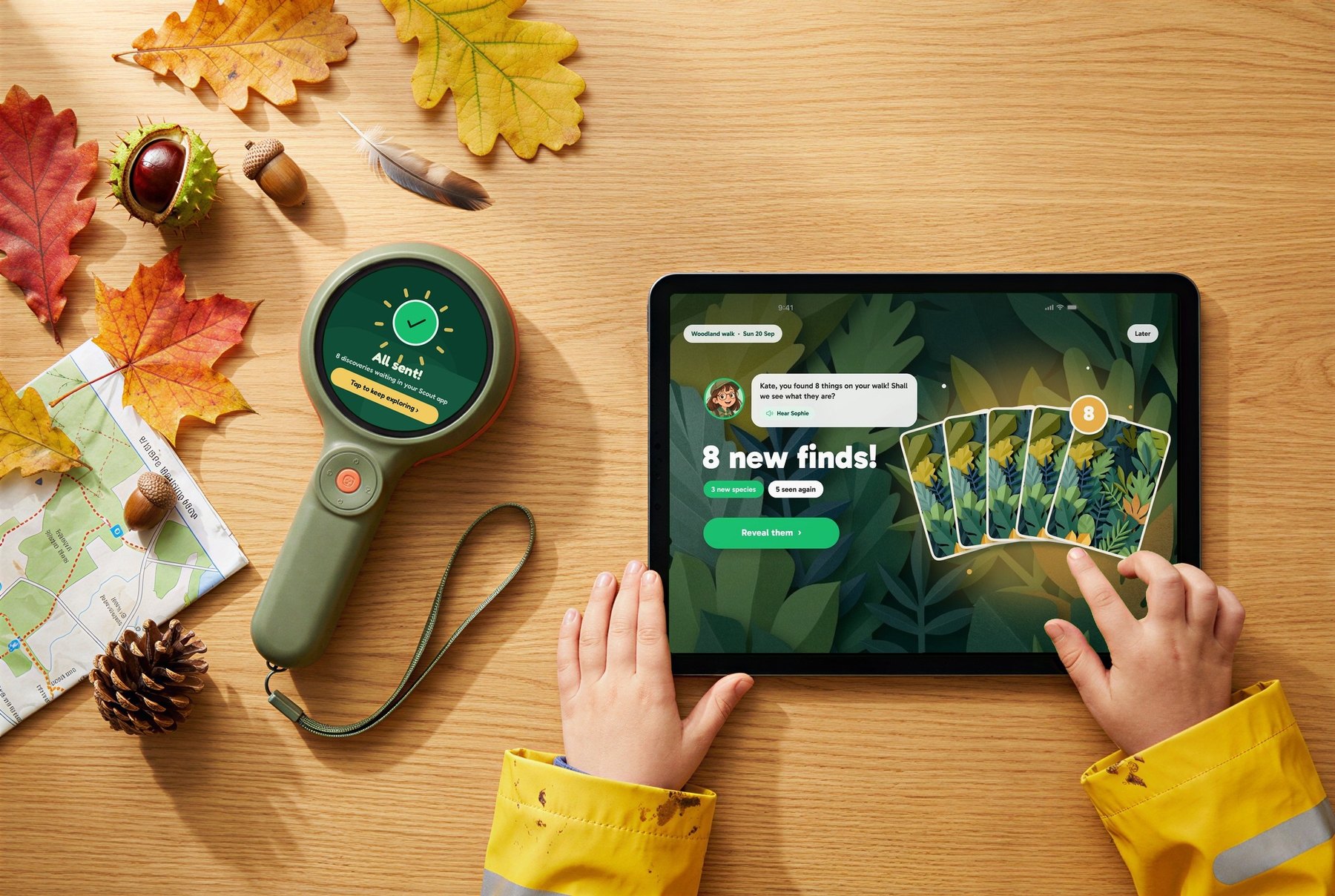
That's what Scout is. It's a nature camera for kids aged 9 to 13, launching on Kickstarter in spring 2027, and it's shaped like an explorer's magnifying glass: a round head with a lens on the front and a round screen made for looking outward on the back, on a grippy handle that sits naturally in a small hand. Everything works with one thumb, from the orange shutter button to the zoom, so the other hand stays free for a branch, a rock or a grown-up's hand. A woven strap goes round the wrist. It's a camera, not a phone: no web browser, no messages, no ads and no app store.
Most identification apps are made for everyone, and some of their keenest users are expert naturalists. Scout is designed for 9 to 13-year-olds from the start:
- A friendly guide character comes along and helps your child work out what they've found. It would rather say "I'm not sure" than tell them something wrong.
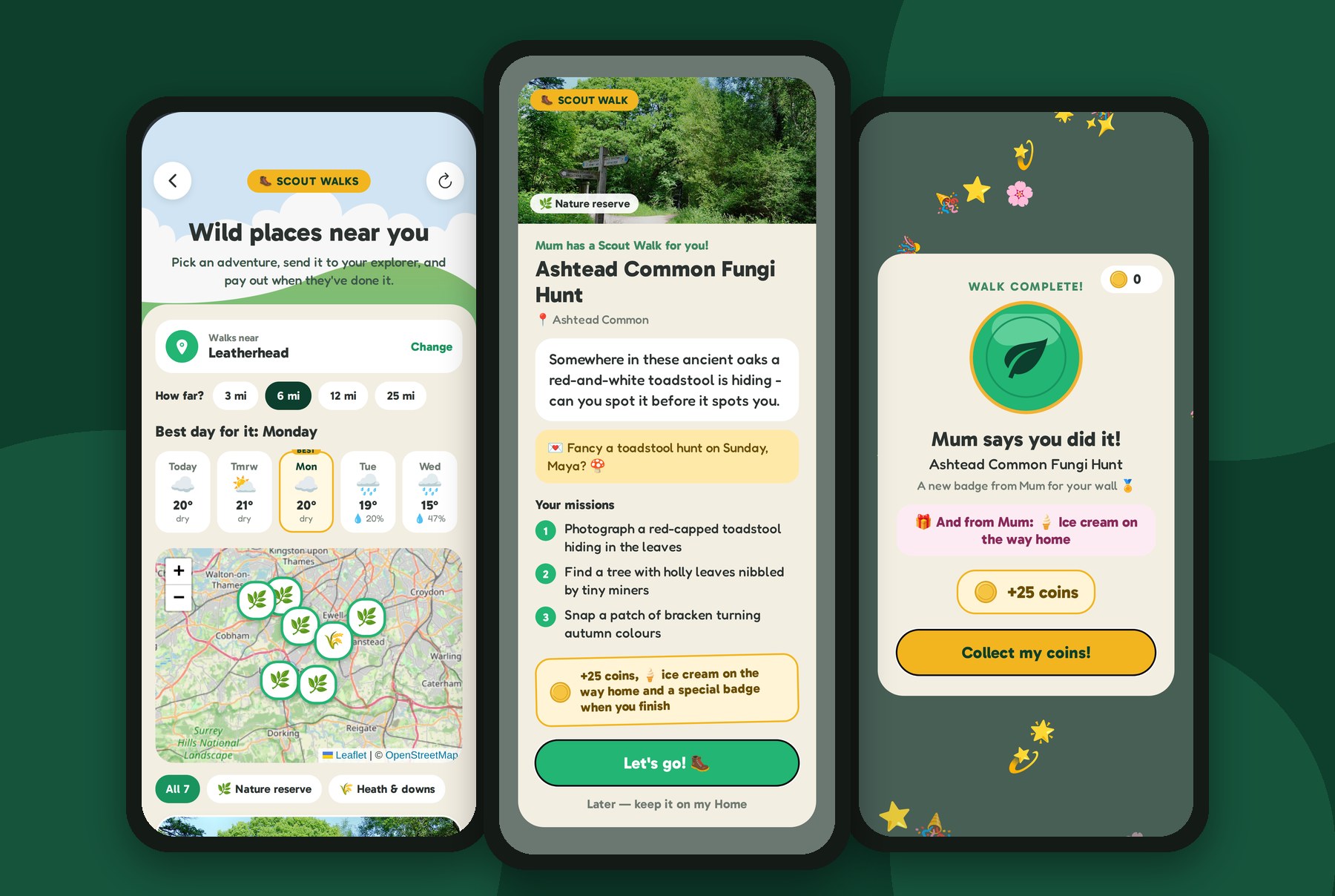
- Back home, the photos go to the free Scout app on the family's phone or tablet. Each new find becomes a Discovery Card, with its name, a painted picture and facts the guide reads aloud.
- Everything grows from real walks. The collection, badges, challenges and a map of the places they've explored only grow when your child goes outside and finds something.
- Rewards are earned, never bought. Coins come from exploring, and there are no leaderboards, so nobody is racing anybody else.
- Photos of people stay on your family's devices.
And there's something quietly powerful about "mine". A camera on their own wrist is a small responsibility: remember it, look after it, bring it home. And their collection is truly theirs: every card in it is something they spotted, pointed at and snapped with their own camera, not a turn they had on yours.
A free app or their own camera: side by side
| A free app on a grown-up's phone | A child's own nature camera | |
|---|---|---|
| Who leads the walk | Whoever holds the phone | The child |
| What else comes along | Messages, notifications, games, a browser | Nothing: it does one job |
| Your phone on the walk | Out, and in use | In your pocket |
| Who it's designed for | Everyone, including expert naturalists | Children aged 9 to 13 |
| Whose finds | Snapped on a grown-up's phone | Snapped by the child |
| A step towards a smartphone? | It's already a smartphone | No |
The short answer
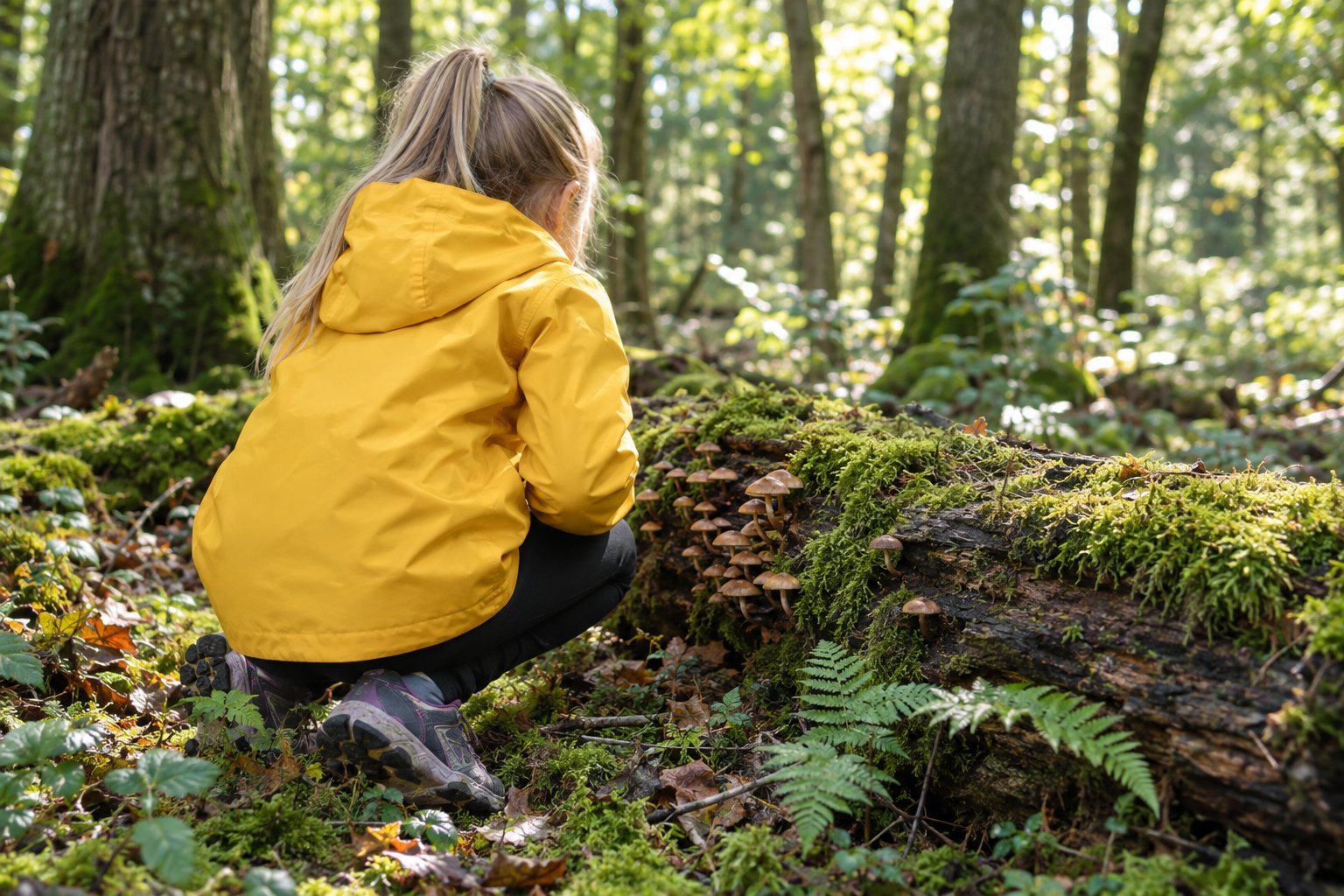
Free nature apps are clever, and they have their place. But on a family walk, the phone they live on brings its buzzes, its games and its pull, and the research says that costs attention and some of the good that time outside does. A camera of their own lets your child lead, keeps your phone in your pocket, and lets you both put your whole attention where it belongs: crouched at the edge of the path, looking closely at something small and alive.
Sources
- iNaturalist: Seek by iNaturalist
- Cornell Lab of Ornithology: Merlin Bird ID
- Common Sense Media: Constant Companion, a week in the life of a young person's smartphone use (2023)
- Stothart, Mitchum & Yehnert (2015), Journal of Experimental Psychology: Human Perception and Performance: The attentional cost of receiving a cell phone notification
-
Jiang, Schmillen & Sullivan (2019), Environment and Behavior: How to waste a break
-
Ofcom: Younger phone owners, the rise of AI, and consumption over creation (2026)
- Wait Until 8th: the pledge
- Pew Research Center: Parents' attitudes and experiences related to digital technology (2020)
- Dwyer, Kushlev & Dunn (2018), Journal of Experimental Social Psychology: Smartphone use undermines enjoyment of face-to-face social interactions
- McDaniel & Radesky (2018), Child Development: Technoference, parent distraction with technology and associations with child behavior problems
- Diehl, Zauberman & Barasch (2016), Journal of Personality and Social Psychology: How taking photos increases enjoyment of experiences
- Barasch et al. (2017), Psychological Science: Photographic memory, the effects of volitional photo taking on memory