Scout Walks: real nature walks near you, sent to your child as an adventure
From Richard, Scout's founder. A first look at Scout Walks in the Scout app, with real screens: how it finds nature walks near you, and why it turns "shall we go for a walk?" into something your child asks you for.
Every parent knows the Saturday morning question: "Where shall we go?" And every parent knows the answer we usually land on: the same park, the same loop, the same "do we have to?" from the back seat. Scout Walks is our answer to that, and I think it might be one of the best things we've built. It finds real nature walks near you, tells you what's been seen there this month, and lets you send one to your child as an adventure, with a reward from you when they've done it.
Here's how it works, with real screens from the Scout app.
How do you find good nature walks near you with kids?
Most walking apps are built for adults: a route, a distance, a gradient. They don't tell you whether there's anything for a ten-year-old to find.
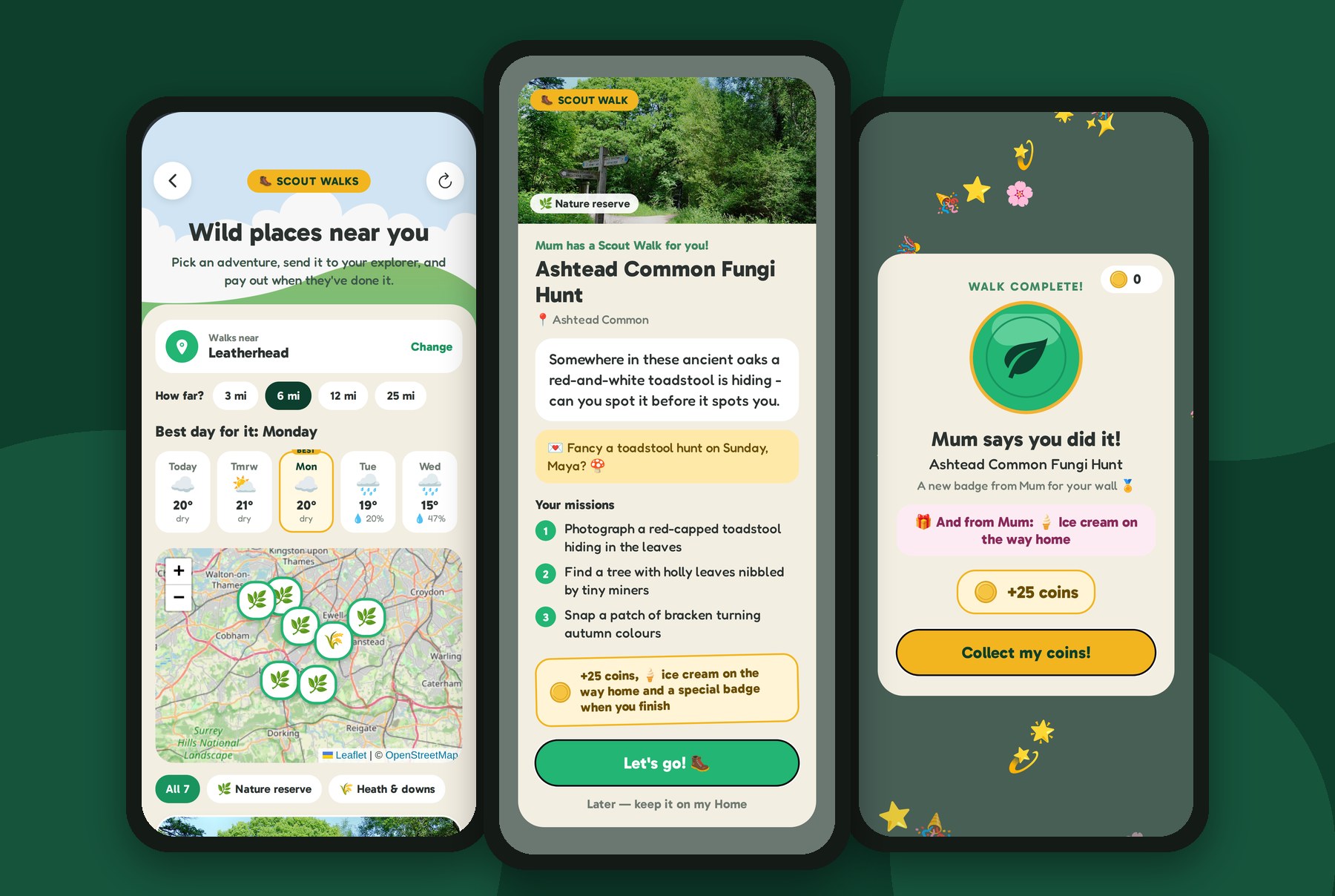
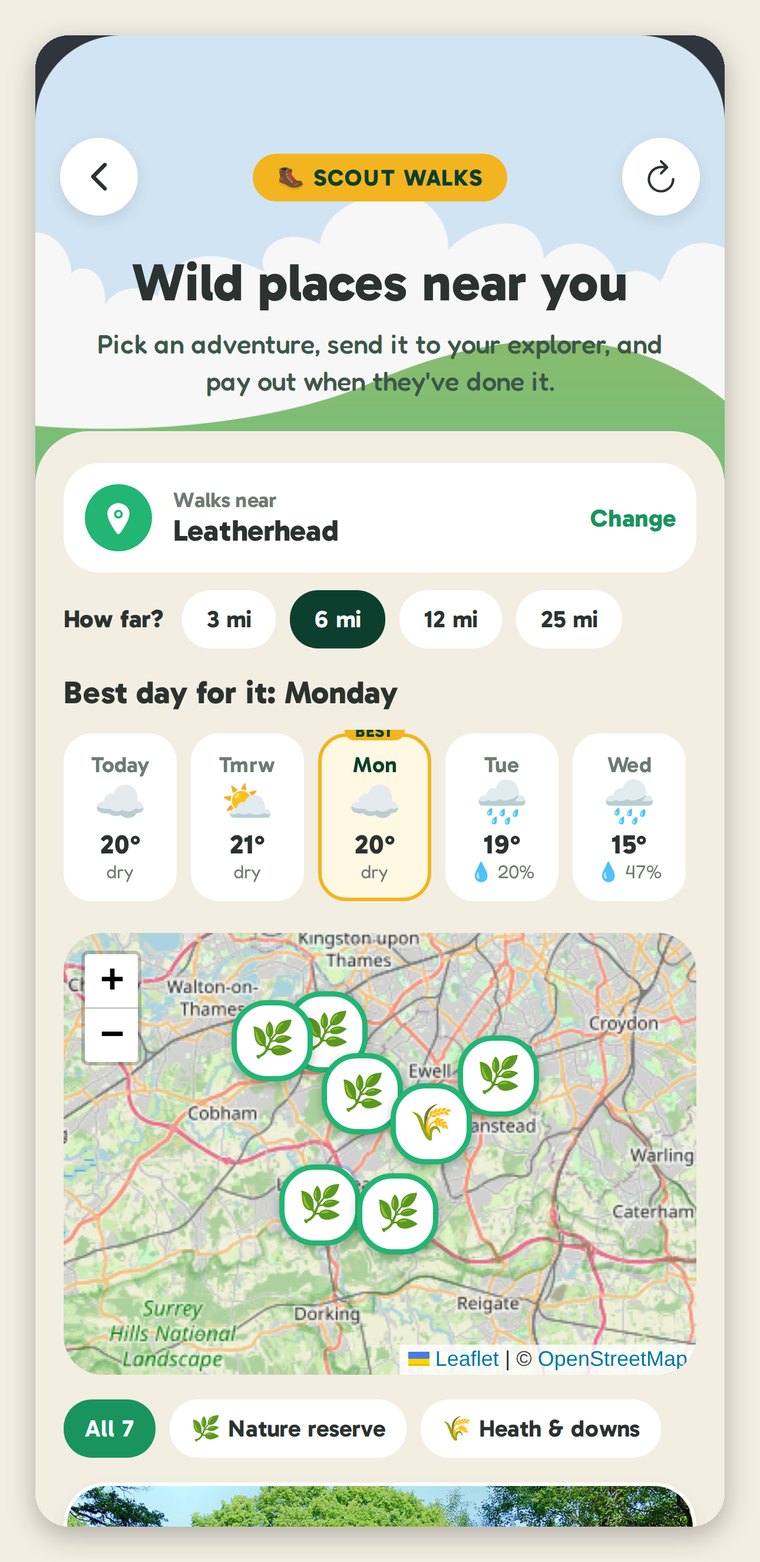
So Scout Walks starts from a different question: which wild places near you have actually had interesting things spotted in them at this time of year? You tell it where you are (your phone's location, or a town you type in) and how far you're happy to go: 3, 6, 12 or 25 miles. Then it does the homework for you:
- The places come from OpenStreetMap: nature reserves, woods, heaths and downs, commons, lakes, beaches and trails.
- What lives there comes from iNaturalist, where naturalists log what they've seen and photographed. Scout Walks looks only at what's been recorded at each place in this month of the year, so in autumn you get fungi and in spring you get bluebells and tadpoles.
- A proper description and a photo come from Wikipedia, where the place has an article (credited on the page).
- The week's weather comes from Open-Meteo, and it picks out the best day to go.
Then Scout writes each place up as a walk, using only what those sources say. It never invents a species: everything in "What you might spot" was recorded there. The first time anyone asks about an area, it takes about a minute to gather all that. After that it's instant.
What it found near us this week
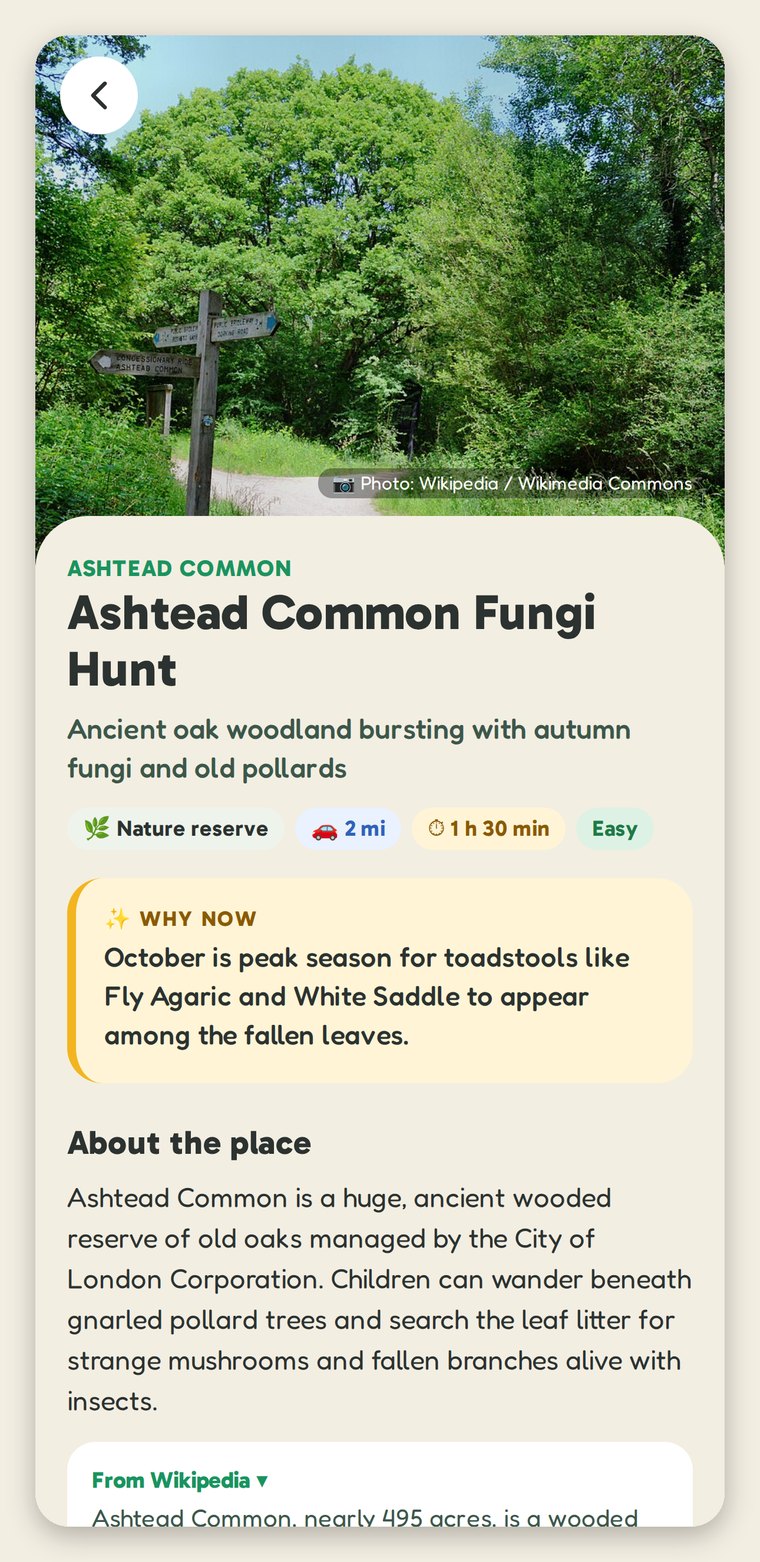
I tried it this week from Leatherhead, in Surrey, at 6 miles. It came back with seven walks, and the first one made me grin: Ashtead Common Fungi Hunt, an ancient oak wood where Fly Agaric and White Saddle fungi have been recorded in October. It also found a pond patrol on Esher Common, a skywatch on Epsom Downs (red kites pass over in autumn), a fungus trail on Headley Heath and a giant polypore hunt in Norbury Park.
Every walk card tells you what kind of place it is, how far away it is, roughly how long it takes and how hard it is ("Easy", or "A bit of a trek"). Tap Read about it and you get the whole plan:
- Why now: what makes this month a good time to go.
- About the place, with the Wikipedia description underneath.
- Three missions for your child, written around what's really there: "Photograph a red-capped toadstool hiding in the leaves."
- What you might spot: the species naturalists have recorded there at this time of year.
- What to pack (wellies, a magnifying glass, a snack).
- Good to know: one sensible line of safety advice for that place. For a fungi wood: keep to paths, look and photograph, never taste or touch.
- Getting there, with directions and a map.
- What your explorer will see, so you know exactly how it'll land.
Sending it: the bit I love most
This is where Scout Walks stops being a list of places and becomes something your child wants to do.
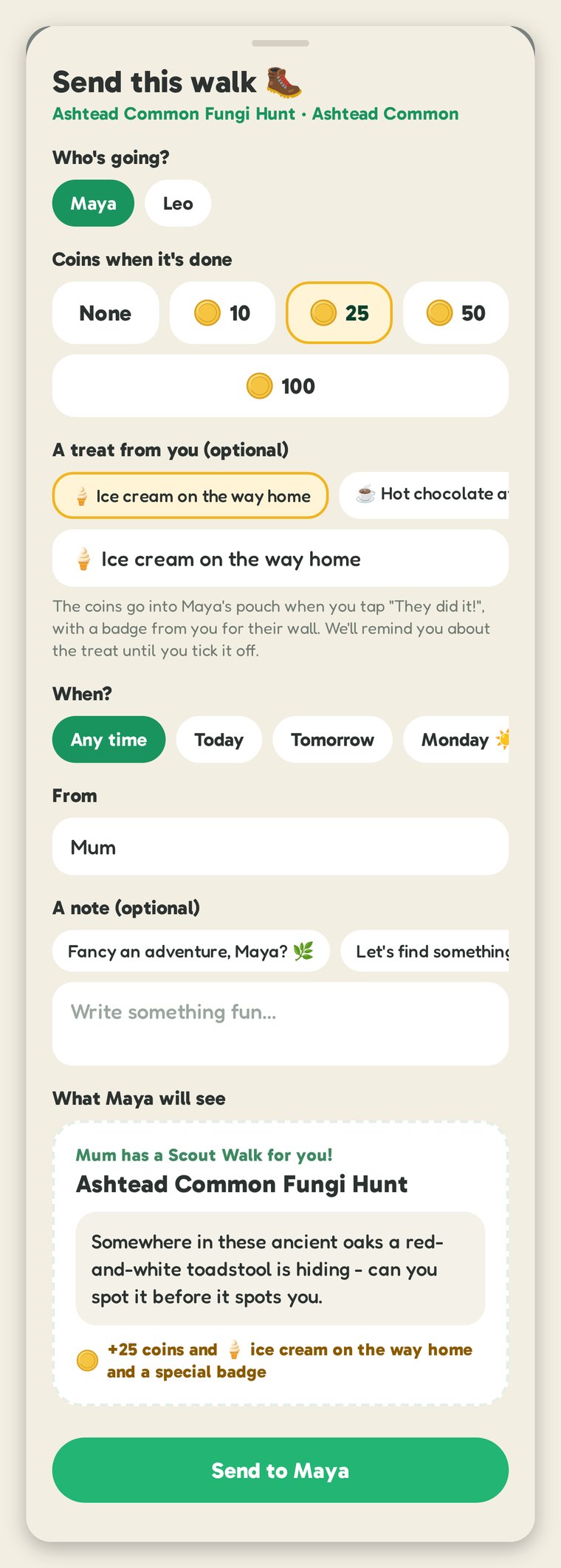
You tap Send to your explorer and choose:
- Who's going, if you've more than one child.
- Coins when it's done: 10, 25, 50 or 100, or none. Coins are earned by exploring, never bought, and your child spends them in the app's shop.
- A treat from you, if you like: "Ice cream on the way home", "Hot chocolate at the café", "You pick what's for dinner", "Stay up 30 minutes later", or anything you write yourself. None of the ideas are about screens, on purpose.
- When: any time, today, tomorrow, or the best day for the weather.
- Who it's from, and a note.
Underneath, you see exactly what your child will see. Then you tap send.
What your child sees
The next time your child opens Scout, it pops up: "Mum has a Scout Walk for you!" The place, a line written just for them ("Somewhere in these ancient oaks a red-and-white toadstool is hiding. Can you spot it before it spots you?"), your note, the missions, and what they'll get when they finish. They tap Let's go!, or Later, and it waits on their home screen.
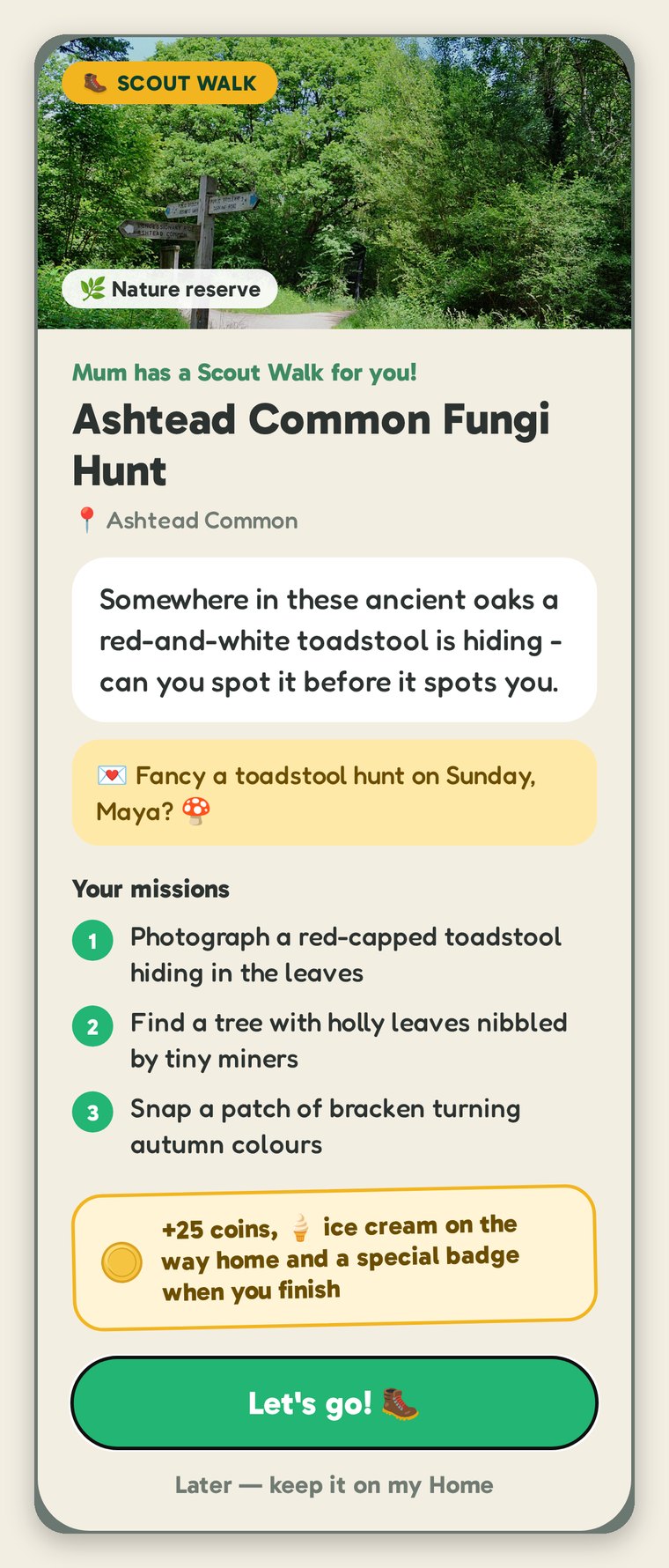
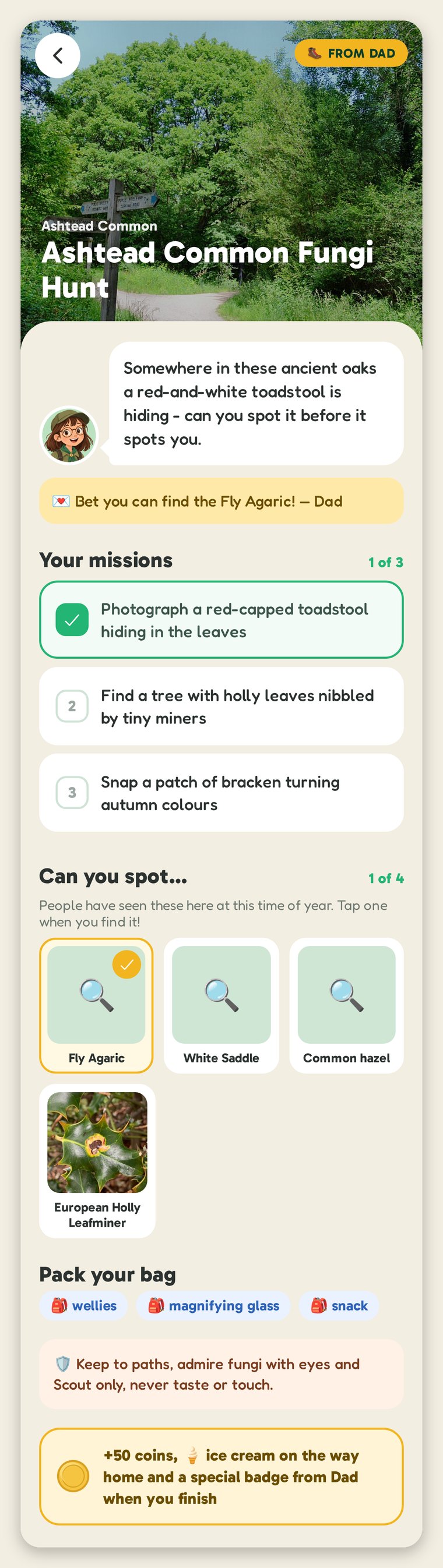
On the walk, their page is a checklist they can tick as they go: the three missions, and "Can you spot…" with the species seen there. There's no map on your child's page. Getting there is the grown-up's job; their job is looking. When they've done it, they tap I've done it!, and you get told.
The pay-off: a badge from you
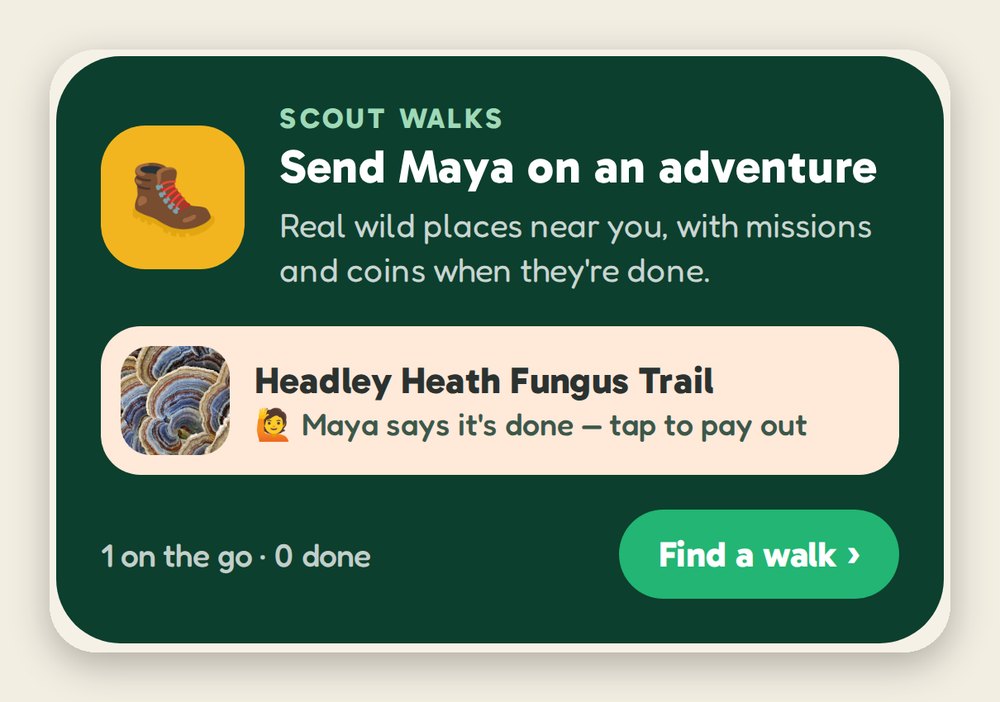
When your child says they're done, it shows on your dashboard: "Maya says it's done. Tap to pay out." You tap They did it!
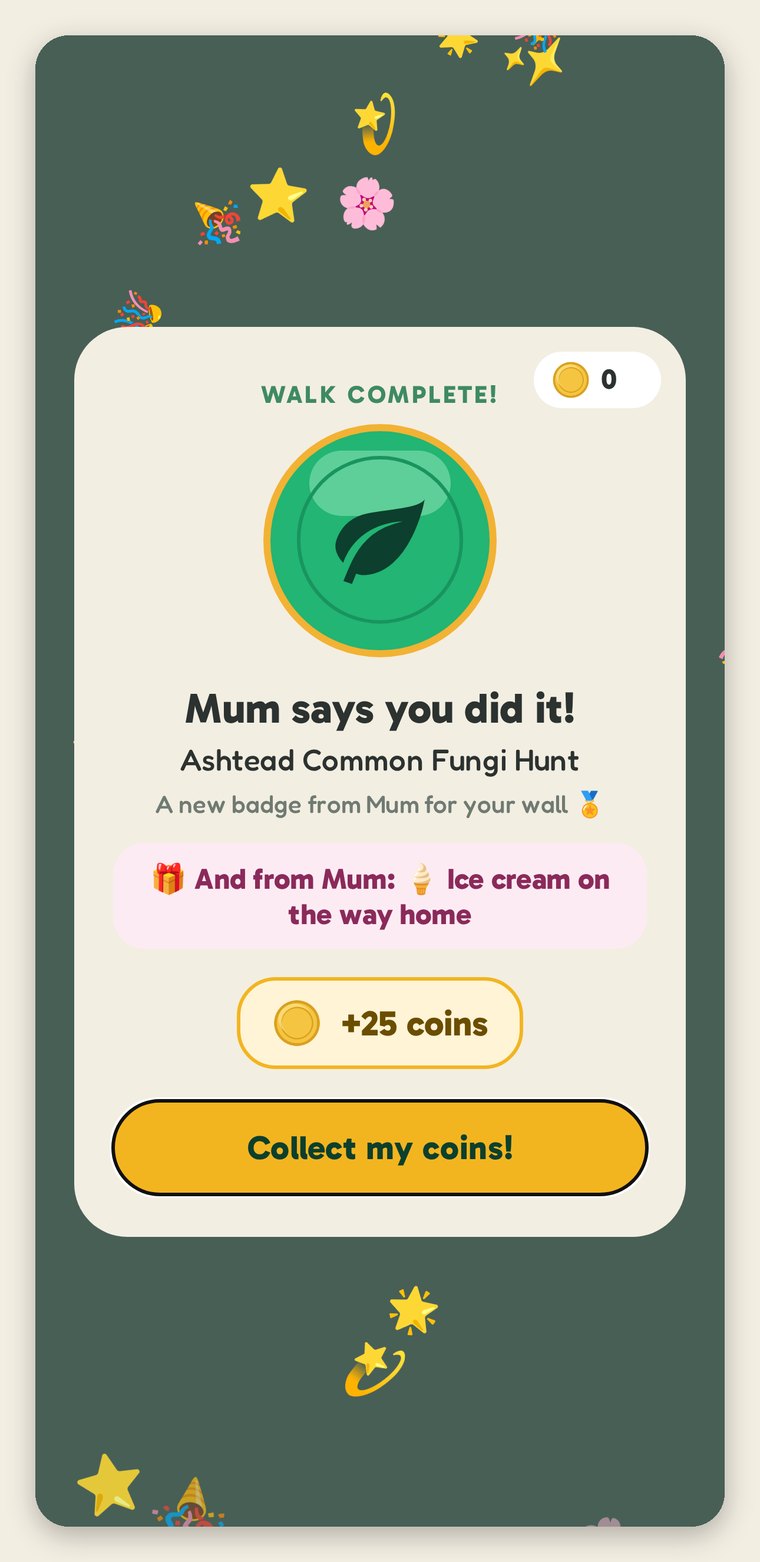
Then the confetti. A brand-new badge spins in: a badge from you, named after the walk, like "A Scout Walk from Mum: Ashtead Common". Your treat is there in writing, and the coins fly into their pouch. The badge goes on their wall with the others, in its own row: From your grown-ups.
And Scout keeps you honest: it reminds you about the treat until you tick it off as given. If your child's Scout finds landed within about a mile of the place after you sent it, it tells you that too.
Why I think it's one of the coolest things we've built
I started Scout because of what screens were doing to my twins. The hardest part of getting them outside was never the walk itself. It was the asking: the negotiation, the sighing, the "can we just stay in?"
Scout Walks flips that round. The walk arrives as an invitation, from you, to somewhere real, with a reason to go now: the toadstools are up this month, and there are three missions and a treat at the end. Suddenly it's your child asking you when you're going.
And it's real. There's no made-up treasure, and every place on the list is a wild place near you. Everything in "What you might spot" has been seen there by real naturalists. The badge on their wall isn't for screen time. It's a record of a day you spent outside together, with your name on it.
A few tips for your first Scout Walk
- Start close and easy. Pick a walk marked "Easy" within 3 or 6 miles for the first one. Leave the big treks until they're hooked.
- Go on the best day. Scout Walks picks out the driest day of the week. Use it.
- Make the treat small and real. A hot chocolate at the café after the walk beats a big promise. It's the bit they'll remember telling their friends about.
- Read "Good to know" first. Every walk has one line of safety advice for that place. Fungi are for looking at and photographing, never for touching or tasting. Check yourselves for ticks after long grass, and always check access and conditions before you set off.
- Ask what they spotted. The missions are a starting point. The best bit is usually something nobody planned.
Where Scout Walks fits in
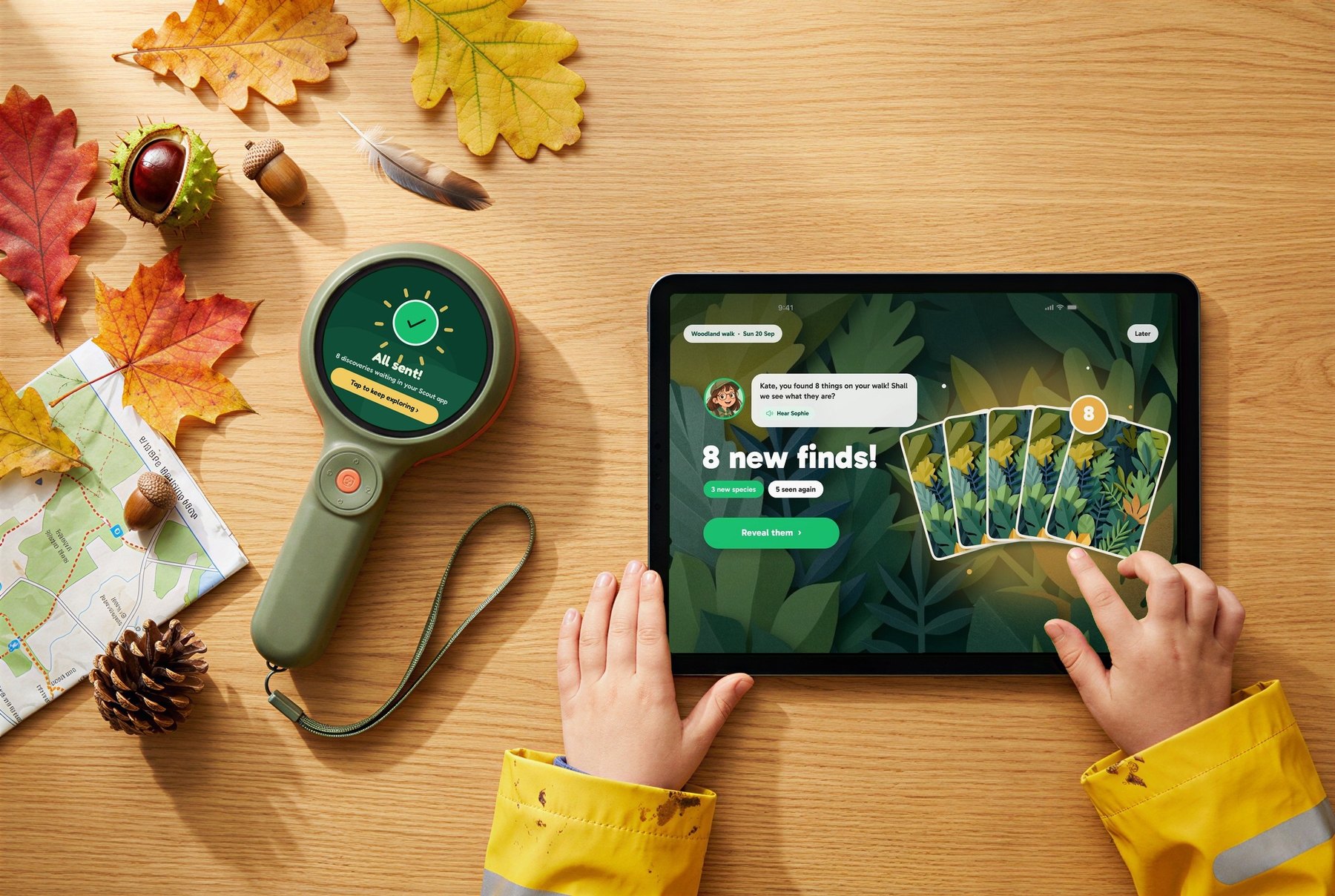
Scout is a handheld nature camera for kids aged 9 to 13, launching on Kickstarter in spring 2027. Scout Walks lives in the grown-ups' side of the free Scout app: you find and send the walks; your child takes Scout and goes exploring. Back home, every find becomes a Discovery Card, a pin on their map and a page in their nature journal.
I can't wait for you to try it. If you do one walk this autumn, make it a fungi hunt. Somewhere near you, a red-and-white toadstool is hiding.
Sources
The places, sightings, descriptions and weather in Scout Walks come from these open sources:
- OpenStreetMap: places and paths, © OpenStreetMap contributors
- iNaturalist: what naturalists have recorded at each place, by month
- Wikipedia: descriptions and photos of places
- Open-Meteo: the week's weather