Nature gifts for kids aged 9 to 13 that actually get them outside
For parents, grandparents and godparents looking for a present that gets a curious 9 to 13-year-old out of the door. No brands and no prices, just what to look for and why it works.
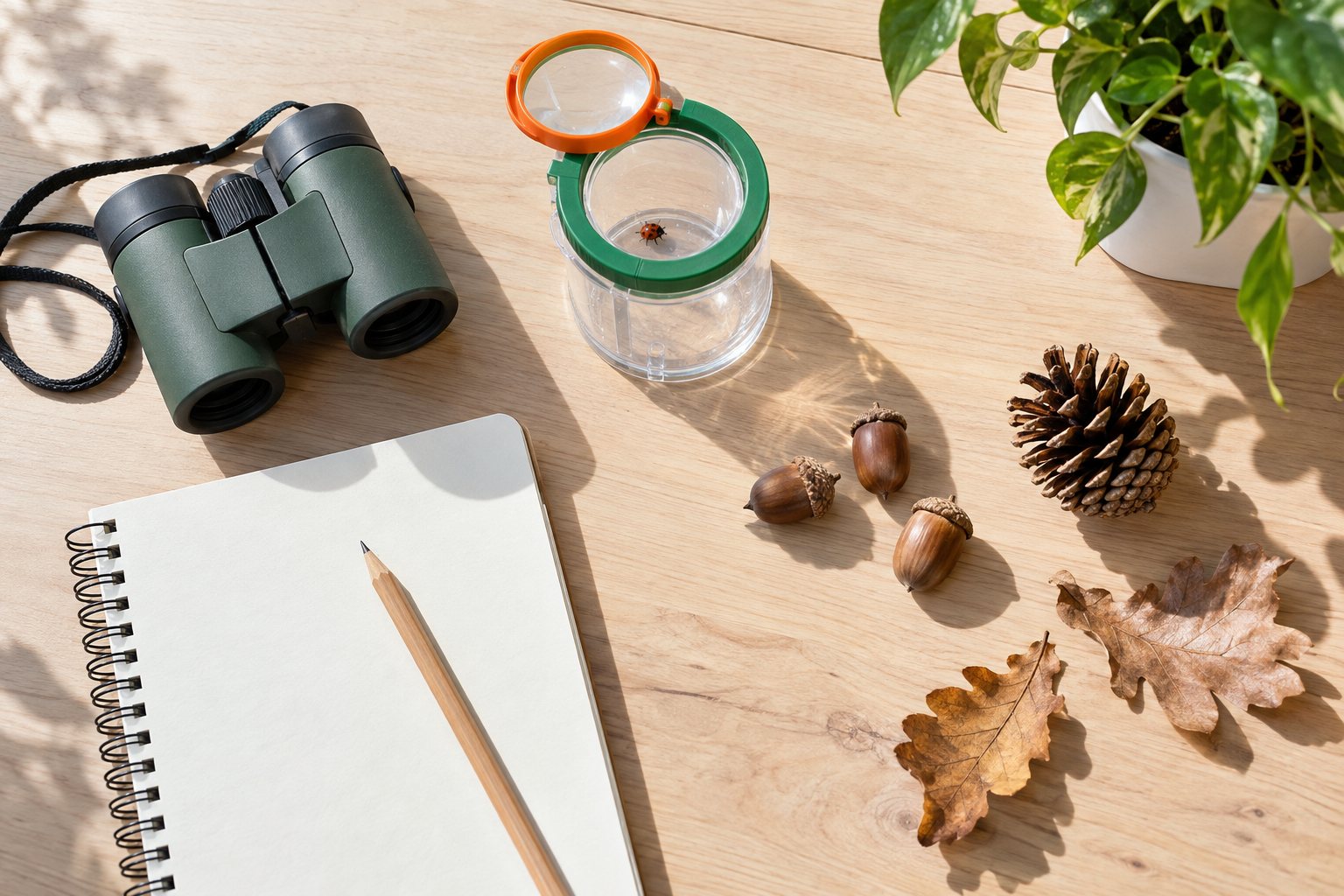
The best nature gifts for kids are the ones that get used on a gray Saturday in February, not the ones that look good on the day and then live in a closet. This list is for curious 9 to 13-year-olds: old enough for real kit, young enough to still lie on their tummy watching a beetle. Every idea comes with what to look for, so you can pick well without needing to be an expert yourself.
What makes a good nature gift?
Before the list, three quick tests:
- Will it go outside? It should fit in a pocket or a small bag, and survive being dropped in a puddle.
- Is it real? Children this age can tell a toy from a tool. A proper hand lens beats a plastic "explorer set" every time.
- Does it lead somewhere? The best gifts start a habit: a feeder leads to a bird list, a journal to a year of notes, a membership to a year of trips.
Gifts for looking closer
A hand lens (loupe). A small folding magnifier, the kind naturalists wear on a cord around their neck. Many carry a 10x lens (it makes things look ten times bigger). The trick is to hold the lens close to your eye and bring the thing you're looking at up to it, not the other way round. Suddenly moss is a forest, a fly has hairy legs and a lichen is a tiny coral reef. Teach one rule on day one: never look at the sun through a lens or binoculars.
A bug pot or pooter. A clear pot with a magnifying lid lets a child look at a beetle without squashing it. A pooter (sometimes called an aspirator) is a jar with two tubes: you suck gently on one (it has a mesh cover, so nothing reaches your mouth), and a tiny insect is drawn up the other into the jar. The rules that go with them: be gentle, keep the pot out of hot sun, look for a few minutes, then put the animal back exactly where you found it. Leave anything that stings, and never use a pooter on anything wet or dusty.
Gifts for looking further
Binoculars. Every pair has two numbers, such as 8x32:
- The first number is the magnification. 8x makes a bird look eight times closer.
- The second number is the width of the big lenses in millimeters. Bigger lenses let in more light but make the binoculars heavier.
For 9 to 13s, 8x is a good choice. It's strong enough to see a bird's face, but not so strong that every tiny wobble shakes the view, and it shows a wide enough patch of sky to find the bird in the first place. Go for a light, compact pair a child can hold steady for a while, and check the two barrels fold close enough together for a narrower face. The Cornell Lab of Ornithology has a helpful guide to choosing binoculars for kids (link below).
Gifts for finding out
A regional field guide. Pick one for where you live: one for your part of the country, since many American guides come in Eastern and Western editions. A guide full of pictures, with a few words about where and when to look, is more fun at this age than a heavy one with every species in the world. Birds are a great first guide because birds turn up every day.
A nature journal kit. Put together a sturdy notebook, a pencil, a few colored or watercolor pencils, a ruler, and a pencil case to keep them dry. Add a card with the three prompts the naturalist John Muir Laws uses: I notice, I wonder, It reminds me of. They turn "a bird" into "a bird with a striped head that I wonder about".
Gifts that bring nature to the window
A bird feeder, plus the first bag of food and a cleaning brush. A feeder outside a window is a gift that keeps arriving every morning. Include the brush and the promise of a grown-up to help clean it, because a clean feeder keeps birds healthy. Our guide to winter backyard birds covers what to put in it and how to keep it safe.
Gifts for going out in any weather
Rain boots. Unglamorous, and the single most useful thing on this list. A child who doesn't mind puddles goes to the interesting places: stream edges, muddy paths, the pond. A size up with thick socks lasts longer.
A headlamp with a red light. Winter gets dark early, and an evening walk is when owls call and foxes are about. A headlamp keeps hands free for a lens or a notebook. A red setting helps your eyes stay used to the dark, and is gentler on night animals than a bright white beam.
Gifts for making and keeping
A flower press. Pressing flowers and leaves turns a walk into something to keep. The rules matter here:
- Pick from your own yard, or with the owner's permission.
- Leave flowers where they grow in parks and nature preserves; in many parks, picking is against the rules.
- Only take common flowers, and never dig up a plant.
Fallen fall leaves press beautifully too, and they're usually fine to collect.
Gifts that last all year: memberships and passes
- A state park annual pass. Many states sell a yearly pass for their parks. Search your state's parks website.
- The Every Kid Outdoors pass. Free for US fourth graders (or the home-school equivalent), it opens federal lands and waters for a school year. Where a site charges per person, it lets in all children under 16 and up to three adults with the pass holder. If your child is in fourth grade, this one costs nothing.
- An Audubon membership. A National Audubon Society membership includes membership of your local chapter, and many chapters run bird walks that welcome families.
Experiences: the gift of a night out
A guided bat walk. Walking at dusk with an expert and a bat detector, a gadget that turns bats' squeaks (too high for our ears) into clicks we can hear, is a moment kids remember for years. In winter most bats are hibernating or have flown somewhere warmer, so bat walks mostly run from late spring to early fall. That makes it a perfect gift to give as a homemade voucher now and enjoy in summer. Look for walks at nature centers, state parks and local bat groups.
Other ideas in the same spirit: a dawn chorus walk, a tide pool walk, a pond exploring session or a stargazing night. Anything with an expert who loves their subject is catching.
What about Scout?
If you've found this page through us: Scout is a nature camera for kids aged 9 to 13, shaped like an explorer's magnifying glass and worked with one thumb, and it launches on Kickstarter in spring 2027. It isn't one for this year's list, so everything above is our honest answer for now.
The gift behind the gift
Whatever you choose, the thing that makes it work is someone to go out with. Tuck a note in with the present, "one walk a month, you choose where", and you've given the best nature gift of all.
Sources
- Cornell Lab of Ornithology: Binoculars for kids
- John Muir Laws: Three prompts for deeper nature observation
- Botanical Society of Britain and Ireland: Code of conduct
- Wildlife Watch: Join
- National Trust: Junior membership
- Every Kid Outdoors: Rules and eligibility
- National Audubon Society: Member benefits
- Bat Conservation Trust: Bat walks