How are species named? How scientists name living things, explained for curious kids
For curious kids and the grown-ups they ask questions. You'll learn how scientific names work, why they're in Latin, how the kingdom-to-species ladder fits together, and why names sometimes change.
Is it a robin? That depends on where you're standing. In Britain a robin is a small bird with an orange-red breast; in America it's a much bigger bird that's a kind of thrush. So how are species named in a way that everyone, everywhere, can agree on? Scientists give every living thing a two-part name, and there's a clever system behind it. Here's how it works, who invented it, and why names sometimes change.
Why do living things need scientific names?
Everyday names, or common names, are lovely, but they cause muddles:
- Robin. In the UK it's Erithacus rubecula. In the US it's Turdus migratorius, a thrush, and a close cousin of the Eurasian blackbird. English-speaking settlers seem to have given it the name because its red-orange breast reminded them of the robin back home.
- Buzzard. In Britain, a buzzard is a broad-winged hawk. In the US, people often use "buzzard" for vultures.
- Daddy longlegs. In the UK it usually means a crane fly, a gangly flying insect. In the US it usually means a harvestman, an eight-legged cousin of spiders.
A scientific name fixes that. Turdus migratorius means exactly one kind of bird, whether you're in Ohio, Oxford or Osaka.
Who invented two-part names?
A Swedish naturalist and doctor called Carl Linnaeus (1707 to 1778), who taught at the University of Uppsala. Before him, plants and animals were often labeled with long Latin descriptions, a bit like naming a dog "the small brown one with the curly tail that barks at the post".
Linnaeus gave each species a short name of just two words. His book Species Plantarum (1753) did it for more than 5,900 plants, and the tenth edition of his Systema Naturae (1758) did it for animals. Scientists still treat those two books as the official starting points for plant and animal names. The system is called binomial nomenclature, which simply means "two-name naming".
How does a two-part name work?
Take our own species: Homo sapiens.
- The first word is the genus (say "JEE-nuss"), a group of close relatives. It starts with a capital letter.
- The second word picks out the species within that genus. It starts with a small letter.
- The whole name is written in italics (or underlined when handwritten).
Close relatives share the first word. The lion is Panthera leo and the tiger is Panthera tigris. The American robin, Turdus migratorius, shares its genus with the Eurasian blackbird, Turdus merula.
Names often describe something. Rubecula means "little red one", migratorius means "migrating", and vulpes is simply Latin for "fox". Some names honor a person or a place instead.
Why are scientific names in Latin?
In Linnaeus's day, Latin was the shared language of scholars across Europe. A Swedish scientist could write in Latin and be understood in France, Germany or England. Latin had another advantage: nobody spoke it as an everyday language any more, so its words weren't going to drift and change.
Today names are built from Latin and Greek, and sometimes from other languages or people's names, but they're always written in a Latin form so they work the same way everywhere.
What is the ladder from kingdom to species?
Scientists sort living things into groups inside groups, like a set of nesting boxes. From the biggest box to the smallest, the main steps are:
kingdom, phylum, class, order, family, genus, species
A memory trick for the order: King Philip Came Over For Good Soup.
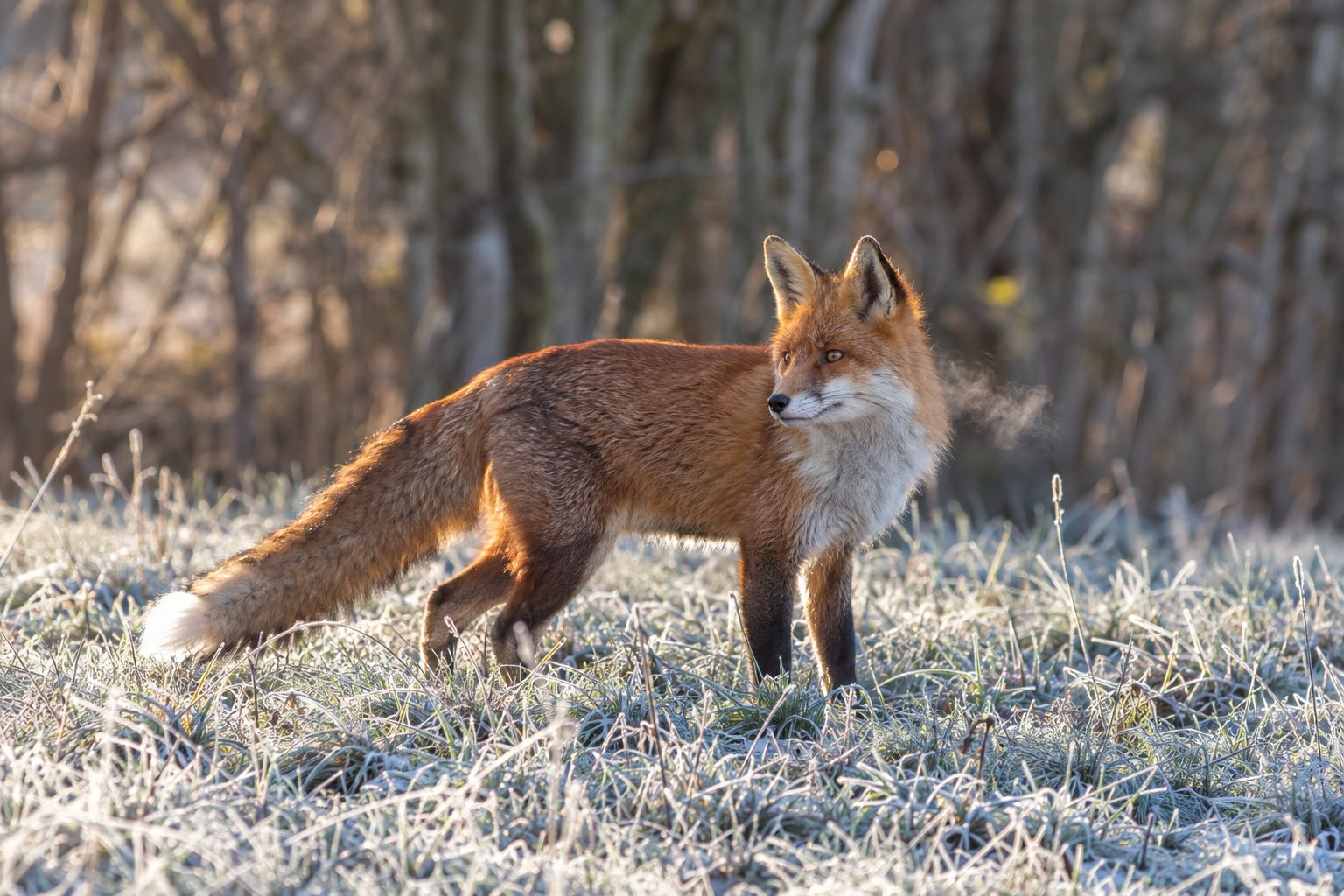
Here's the red fox, which lives in both Britain and North America, climbing down the ladder:
| Step | The red fox's group | Who else is in it? |
|---|---|---|
| Kingdom | Animalia (animals) | Every animal, from sponges to spiders to us |
| Phylum | Chordata (chordates) | Mostly animals with a backbone: fish, frogs, birds, mammals |
| Class | Mammalia (mammals) | Furry animals that feed their babies milk |
| Order | Carnivora (carnivorans) | Cats, dogs, bears, seals and weasels, plus the giant panda, which mostly eats bamboo |
| Family | Canidae (the dog family) | Dogs, wolves, coyotes, jackals and foxes |
| Genus | Vulpes (true foxes) | The Arctic fox, Vulpes lagopus, and the fennec fox, Vulpes zerda |
| Species | Vulpes vulpes | Just the red fox |
Notice that the red fox's two words are the same. Repeating the genus like that is allowed for animal names, but not for plants.
Each step down the ladder is more exact. "An animal" is true but not very helpful; "a mammal" is better; "a fox" better still; "a red fox" is exactly right. Some scientists add an even bigger step above kingdom, called a domain.
Why do scientific names change?
Because scientists keep learning. Studying DNA has shown that some animals that looked alike weren't as closely related as everyone thought, so they were moved to new genera (the plural of genus):
- The blue tit used to be Parus caeruleus. It's now Cyanistes caeruleus.
- The black-capped chickadee used to be Parus atricapillus. It's now Poecile atricapillus.
Sometimes scientists argue about where one species ends and another begins. Some think North American red foxes are different enough to be their own species, Vulpes fulva. Others, including the American Society of Mammalogists, keep them all as Vulpes vulpes until there's more evidence.
There are international rulebooks for naming animals and plants, so these changes aren't random. Usually the oldest properly published name wins. A name change doesn't mean anyone was silly: it means science is working.
How does Scout use the naming ladder?
Scout's guide is built to use this same ladder. When it isn't sure of the exact species, it climbs back up instead of guessing. It might say "some kind of thrush" (a family) or simply "a bird" (a big group), because a true answer at a higher step beats a wrong species. It only names a group when it's right at least 85 times in 100, and otherwise it would rather say "I'm not sure", which is exactly what a good scientist does.
Try it yourself
- Look up three living things near you and find their scientific names. A field guide, a museum website or a nature app will usually show them.
- Hunt for repeaters. Find a scientific name where both words are the same, like Vulpes vulpes.
- Spot the cousins. Find two animals that share a first word, like Panthera leo and Panthera tigris.
- Name something new. Invent a two-part Latin-style name for your pet or your favorite tree, using what it looks like or where it lives.
Every name tells a story
A scientific name is a tiny address: it tells you exactly which living thing you mean, and which family it belongs to. Learn a few, and you'll start seeing the family tree of life everywhere, from the fox at the edge of the woods to the robin on your lawn.
Sources
- Britannica: Carolus Linnaeus: classification by natural characters and Systema Naturae
- Wikipedia: Species Plantarum and 10th edition of Systema Naturae
- Washington State University, Ask Dr. Universe: Why do scientists use Latin when they name organisms?
- Wildlife Online: Red fox taxonomy and Are North American and European red foxes different species?
- Discover Wildlife: Guide to tautonyms and binomial nomenclature
- GBIF: Cyanistes caeruleus
- Birds of the World: Black-capped chickadee