How to teach kids about nature when you don't know the names of anything
For parents who'd love to explore nature with their child but worry they don't know enough. You'll get questions that work better than answers, a three-part routine, and easy ways to find out together.
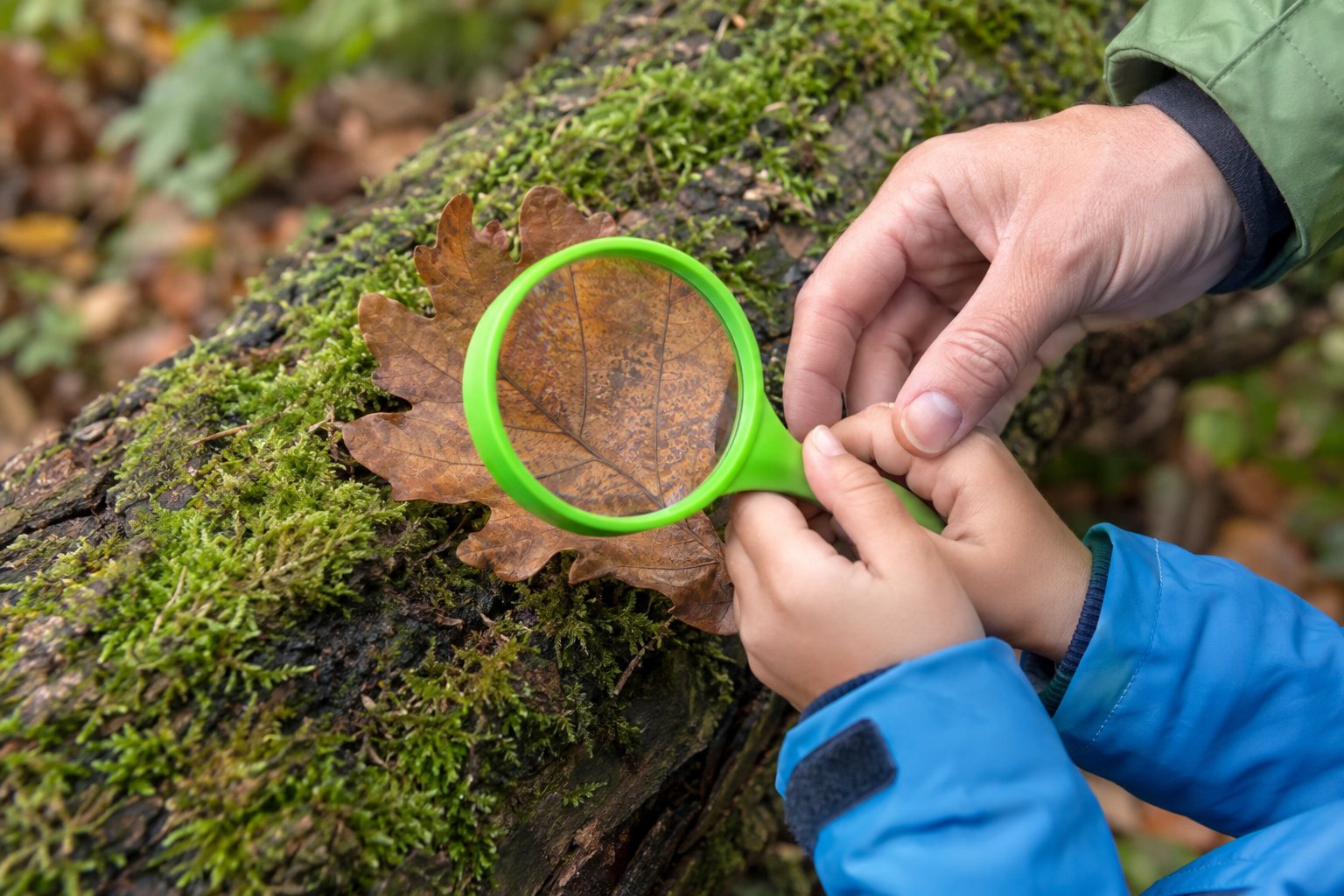
Your child holds up a beetle and asks, "What's this?" And you have no idea. If that makes you feel you can't teach them anything about nature, this post is for you. The secret of how to teach kids about nature is that you don't need to know the names. Here's why, plus the questions to ask instead of answers, a simple three-part routine, and easy ways to find things out together.
Do you need to know the names to teach kids about nature?
No. A name is the smallest part of knowing something. You could know a bird is called a robin and still not know what it eats, where it sleeps or why it sings at dusk. Two minutes of watching it together will probably teach your child more than the name ever could.
The real skills are noticing, wondering and finding out. You can do all three without knowing a single name.
The biologist Rachel Carson, writing in 1956 about exploring the Maine coast with her young grandnephew, put it like this: "I sincerely believe that for the child, and for the parent seeking to guide him, it is not half so important to know as to feel." She wrote that to keep their "inborn sense of wonder", a child needs "the companionship of at least one adult who can share it, rediscovering with him the joy, excitement and mystery of the world we live in." Notice what she asks for: a companion, not an expert.
Why "I don't know, let's find out" is a scientist's answer
Scientists spend their working lives on questions nobody knows the answer to yet. So when your child asks what something is and you don't know, you're not failing. You're showing them exactly how real science starts. Say it cheerfully: "I've no idea. Let's be detectives."
What to ask instead of giving answers
Questions keep a child looking. Answers often end the conversation. Try swapping like this:
| Instead of… | Try asking… |
|---|---|
| "That's a snail." | "What do you notice about it?" |
| "It's a fungus." | "What does it remind you of?" |
| "Leaves go brown in the fall." | "Why do you think these leaves are changing color?" |
| "Don't know, sorry." | "How could we find out?" |
| "It's just a bird." | "Where do you think it's going?" |
The best questions have no wrong answer. A guess is just a hypothesis: a scientist's word for an idea you can test.
The "I notice, I wonder, it reminds me of" routine
If you only take one thing from this post, take this. These prompts were popularized by John Muir Laws, a naturalist, nature journaling teacher and research associate of the California Academy of Sciences in San Francisco. They work on anything, at any age, and they need no expert knowledge at all.
- I notice… Say exactly what you can see, hear or smell. "I notice it has two pairs of feelers. I notice it left a shiny trail."
- I wonder… Ask questions, with no pressure to answer them. "I wonder where it goes when it's sunny. I wonder how old it is."
- It reminds me of… Make connections. "It reminds me of a tiny tank. It reminds me of the one we found by the back door."
Take turns: your child will often notice things you missed. To put this on paper, our guide to starting a nature journal builds a whole notebook around these three prompts.
Learn five common things near home first
You don't need to learn hundreds of species. Pick five common ones you'll see almost every day, and learn them together.
Good first five across much of the US:
- American robin: a gray-brown back and a warm orange breast, often hopping on lawns.
- Mourning dove: soft tan-gray, with a sad-sounding "hoo-OO-oo" coo.
- Oak tree: leaves with lobes, and acorns in the fall.
- Dandelion: yellow flowers, then fluffy seed heads.
- Eastern gray squirrel: gray, bushy-tailed and busy burying nuts.
Then add one a week. Trees make a great next step: our guide to identifying trees by their leaves shows you the six clues to look for.
How to find out together
When you hit something you don't know, you have plenty of free helpers.
- A field guide. A pocket guide or fold-out chart from the library. Looking through the pictures together teaches your child what to check: shape, color, size, where it lives.
- Seek by iNaturalist. A free app from the iNaturalist team, made with kids and beginners in mind. Point a phone camera at a plant, animal or fungus and it suggests what it might be. It needs no account, and it blurs your location to keep it private.
- iNaturalist. You share a photo, and a community of naturalists helps put a name to it. Accounts are for people aged 13 and over, so for younger children a grown-up signs up and you use it together.
- Merlin Bird ID. A free app from the Cornell Lab of Ornithology. You can answer a few simple questions about a bird, share a photo, or record a song, and it suggests what it might be.
Treat every app as a helper, not a judge. Read its suggestion, then look again: "It says wood thrush. Does it have the spotty chest?" That second look is where the learning happens.
Watch one tree through the year
Choose one tree you pass often, on the way to school or in the park. Visit it every week or two and notice what's changed: buds, leaves, flowers, seeds, bare branches. Who's living in it? When do the leaves turn?
You don't need to know what kind of tree it is to start. By the end of the year your child will know that tree really well, and finding out its name will feel like the easy bit.
Keep a list
A running list of everything you've spotted is simple and surprisingly exciting. Write the date and place next to each find. "Small brown bird, spotty chest" is a perfectly good entry; add the name when you find out.
To take your lists further, our guide to citizen science for kids shows how your sightings can help real scientists.
Go out with a local expert
Every so often, borrow someone else's knowledge. Many state parks have naturalists who lead free or low-cost walks and programs, and national parks run ranger-led programs plus a free Junior Ranger program for kids. Nature centers often run family walks too.
Watch closely: good naturalists ask as many questions as they answer, and say "I'm not sure, let's look closer" more often than you'd expect.
Be honest when you're wrong
You'll get things wrong. Everyone does. When it happens, say so, happily: "I said that was a crow, but look, it's got a bright yellow eye and a long tail. It's a grackle!"
That teaches something precious: changing your mind when you see new evidence is a strength, and it's exactly how science works.
A few safety rules stay the same whatever you know. Never touch or taste wild fungi or berries. Handle small animals gently, or just look, and put everything back where you found it. Leave nests alone. And check for ticks after walking through long grass.
Learning alongside your child
We built Scout, the handheld nature camera for kids aged 9 to 13 that we're launching on Kickstarter in spring 2027, for exactly this kind of finding out together. On the walk, Scout's own AI chip names what your child has found, right there, and their guide would rather say "I'm not sure" than tell them something wrong. Back home, each new find becomes a Discovery Card with facts the guide reads aloud: something to listen to, talk about and wonder over side by side, not a job handed over to a gadget.
You already know enough
You don't need a head full of names. You need curiosity, a few good questions and the willingness to say "I don't know, let's find out". Next time your child holds up a beetle, crouch down beside them and ask, "What do you notice?" Learning together is the best kind of teaching there is.
Sources
- The Marginalian, Rachel Carson on wonder, parenting, and why it is more important to feel than to know (quoting The Sense of Wonder, first published in 1956 as "Help Your Child to Wonder")
- Wisconsin Academy of Sciences, Arts and Letters, Rachel Carson and a childhood sense of wonder
- John Muir Laws, NJC, Episode 2: I notice, I wonder, It reminds me of
- John Muir Laws, Biography
- iNaturalist, Seek by iNaturalist and Seek privacy policy
- iNaturalist, Terms of use
-
Cornell Lab of Ornithology, Merlin Bird ID
-
National Park Service, Junior Ranger programs
- Cornell Lab of Ornithology, All About Birds, Common grackle