How to start a nature journal for kids (and keep it going as a family)
For families who'd like to slow down and notice more on their walks. You'll get the kit, three simple prompts, drawing tips for people who "can't draw", and ways to keep the journal going.
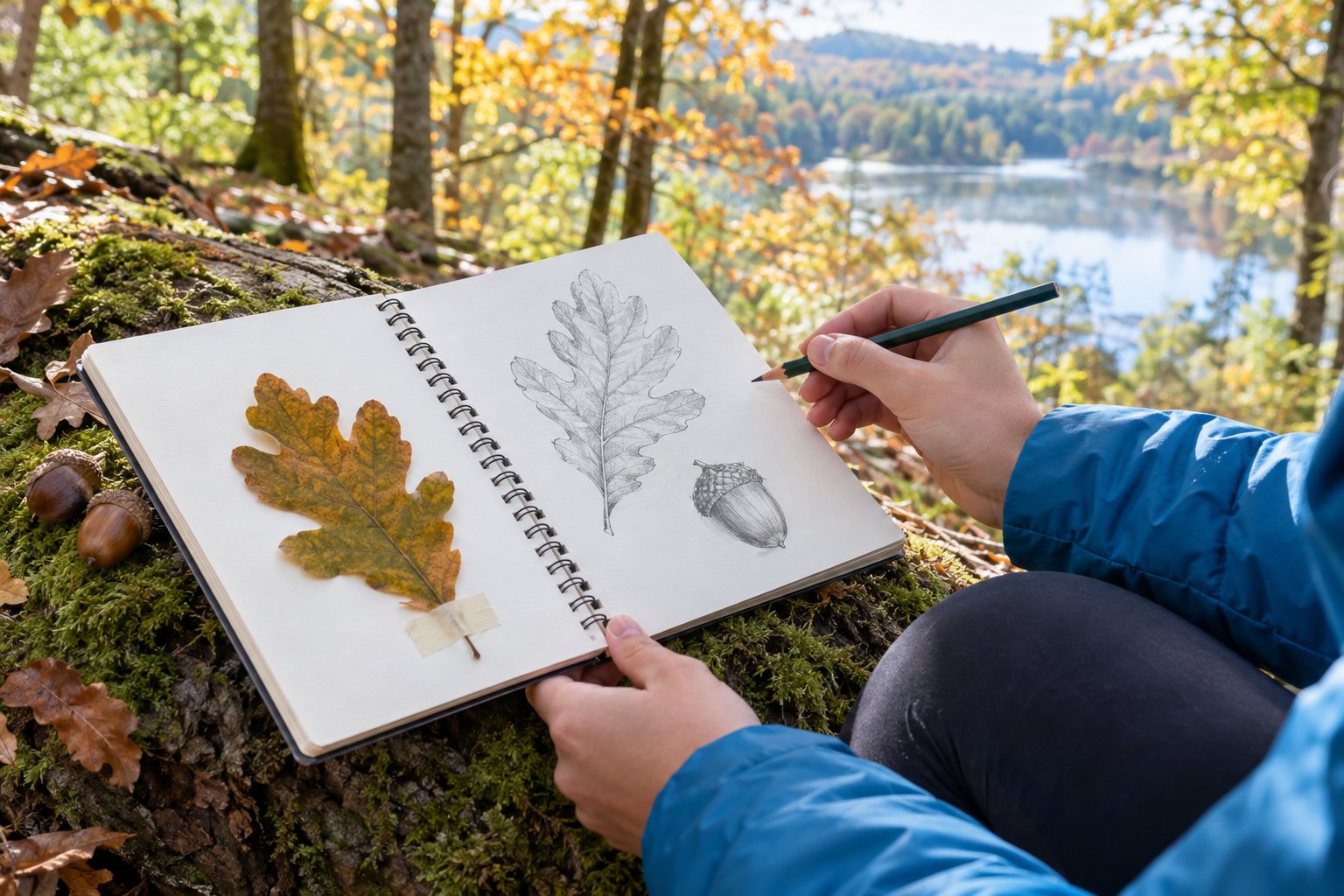
A nature journal for kids is just a notebook where you record what you find outside, in drawings, words and numbers. That's it. It isn't a test, it doesn't need to be neat, and nobody has to be good at art. For 9 to 13 year olds it's one of the best ways to turn a walk into real observation, the thing scientists do.
This guide covers the simple kit you need, three prompts that make a blank page easy, drawing tips for people who say they can't draw, how to press leaves, and how to keep the journal going as a family.
What you need to start a nature journal
Keep the kit small enough to fit in a coat pocket or a small bag. If it's a hassle to carry, it won't come out.
- A notebook. A small sketchbook with thick, plain paper is ideal. About 6 by 8 inches is a good size. Thicker paper copes with a bit of damp and some color.
- A pencil and an eraser. A soft pencil (2B) is lovely for sketching.
- A waterproof fine pen, for going over lines you like.
- A few colored pencils. Six is plenty: two greens, a brown, a yellow, a red and a blue.
- A small ruler, for measuring leaves, feathers and footprints.
- A hand lens or magnifying glass, if you have one.
- Two binder clips, to stop pages flapping in the wind.
Should each child have their own journal, or should the family share one? Both work. Many families do both: each child keeps their own, and there's a shared "family book" for walks you all take together. Grown-ups keeping a journal alongside is the single best way to show it matters.
The three prompts: I notice, I wonder, it reminds me of
The easiest way to fill a page is with three short prompts popularized by the naturalist and teacher John Muir Laws, who has spent years teaching nature journaling to children and adults:
- I notice… Write or draw exactly what you can see, hear or smell. "I notice the leaf has seven points. I notice one side is darker."
- I wonder… Write down questions. They don't need answers. "I wonder why the holes are all near the edge. I wonder what ate it."
- It reminds me of… Make connections. "It reminds me of a hand. It reminds me of the tree in Grandma's yard."
These work at any age and on any subject: a snail, a cloud, a puddle, a feather. They also stop the "I don't know what to write" problem, because there's always something to notice.
Laws also suggests using words, pictures and numbers together on each page. A drawing, a few labels, and a measurement or a count ("12 ants on this stone", "leaf 3½ inches long") make a page far more interesting than any one of them alone.
Always start with the date, place and weather
Before anything else, write in the top corner:
- the date and time
- where you are
- the weather (or draw a little weather symbol)
It takes thirty seconds, and it's what makes a journal useful later. Scientists call this kind of background information metadata, which just means "information about the information". It's how you'll know, next year, that the first blackberries appeared a week earlier, or that the frog eggs appeared after a warm spell.
Drawing tips for people who "can't draw"
A nature journal drawing is about looking, not art. These tips help everyone, whatever their age.
- Look more than you draw. Spend longer looking at the leaf than at the page. Most drawing mistakes are looking mistakes.
- Draw big. Fill a good part of the page. Small drawings get fiddly.
- Start with the big shape. Is the leaf an oval? A triangle? A hand? Lightly sketch that first, then add the details.
- Draw what you see, not what you think. A real leaf is rarely a perfect symmetrical shape. Look for the bent tip, the nibbled edge, the vein that's off-center.
- Add a zoom box. Draw a small square next to your drawing with a close-up of one detail: the teeth on the edge, a bug's leg, the pattern on a feather.
- Label it. Arrows and labels ("fuzzy underneath", "sticky", "smells of lemon") do a lot of the work.
- Set a timer. Two-minute sketches take away the pressure. Do three quick ones instead of one slow one.
- Never rub out a whole drawing. Messy pages are real pages. The point is what you noticed.
If a child really doesn't want to draw that day, that's fine too. A page of words, a list, a map of the walk or a photo stuck in all count.
How to press leaves and flowers for your journal
Pressed leaves make a journal feel special. Collect only fallen leaves, or common plants where you're allowed to pick. Never pick wildflowers in parks and preserves, and leave anything rare alone.
- Choose leaves that are dry and flat. Wet ones go moldy.
- Lay them between two sheets of plain paper (paper towels, printer paper or newspaper all work).
- Put the paper inside a big, heavy book, then stack more books on top.
- Leave it for about one to two weeks, until the leaves are dry and papery.
- Stick them into your journal with thin strips of tape across the stems.
Use your own old books, not ones from the library. The damp can wrinkle the pages.
How to keep a nature journal going
Starting is easy. Keeping going is the hard part. These ideas help:
- Keep it where you'll see it. By the door, in the walking bag, next to the boots.
- Pick a regular spot. Choose one tree, pond or corner of a park and visit it once a week. Draw the same view each time and watch the seasons change it.
- Keep lists. A running list of every bird, butterfly or tree you've spotted grows into something to be proud of.
- Do a monthly "first" page. The first acorn, the first frost, the first swallow, the first daffodil.
- Don't mark it. No corrections, no "that's not quite right". It's their journal, not homework.
- Share it. Let kids show the journal to a grandparent or read out a page at dinner.
- Join a project. Recording when things happen each year is called phenology, and your observations can help real scientists. The USA National Phenology Network's Nature's Notebook asks people to record things like when plants flower and leaves change color.
Nature journal prompts to try on your next walk
Stuck for ideas? Pick one:
- Find three leaves and draw what's the same and what's different.
- Sit for five minutes and write down every sound.
- Draw a map of your walk and mark where you saw each creature.
- Choose one tree and draw it from far away, then one small part of it close up.
- Find something that's changing: a leaf turning, a fruit ripening, a puddle drying.
- Draw a spider's web, then count the spokes.
- Write down one "I wonder" question and try to find the answer at home.
Wrapping up
A nature journal doesn't need to be beautiful. It needs to be used. A notebook full of scruffy sketches, muddy fingerprints and "I wonder" questions is worth far more than a tidy one that stays on a shelf. Start with one page on your next walk, and see where it leads.
Sources
- John Muir Laws, NJC, Episode 2: I notice, I wonder, It reminds me of
- John Muir Laws, Metadata Maps!
- John Muir Laws and Emilie Lygren, How to Teach Nature Journaling: Curiosity, Wonder, Attention (Heyday, 2020)
- Woodland Trust, Nature's Calendar
- USA National Phenology Network, Nature's Notebook