Why are there so many spiders in the fall? The real reasons
For families who've noticed webs everywhere and big spiders indoors. You'll learn why it happens, how to watch a spider build its web, which spiders to leave alone where you live, and why spiders are good news.
Why are there so many spiders in the fall? It can feel like they appear overnight: webs across every path, a big spider in the bathtub, another one sprinting across the living room floor. The good news is that there isn't really an invasion. There are two simple reasons, and both are brilliant things to watch.
In short: the garden spiders that hatched in spring are now fully grown, so their webs are big and easy to see. And indoors, male house spiders are wandering in search of a mate. Here's the detail, plus how to watch a web being built and which spiders to be careful of.
Reason 1: garden spiders are fully grown
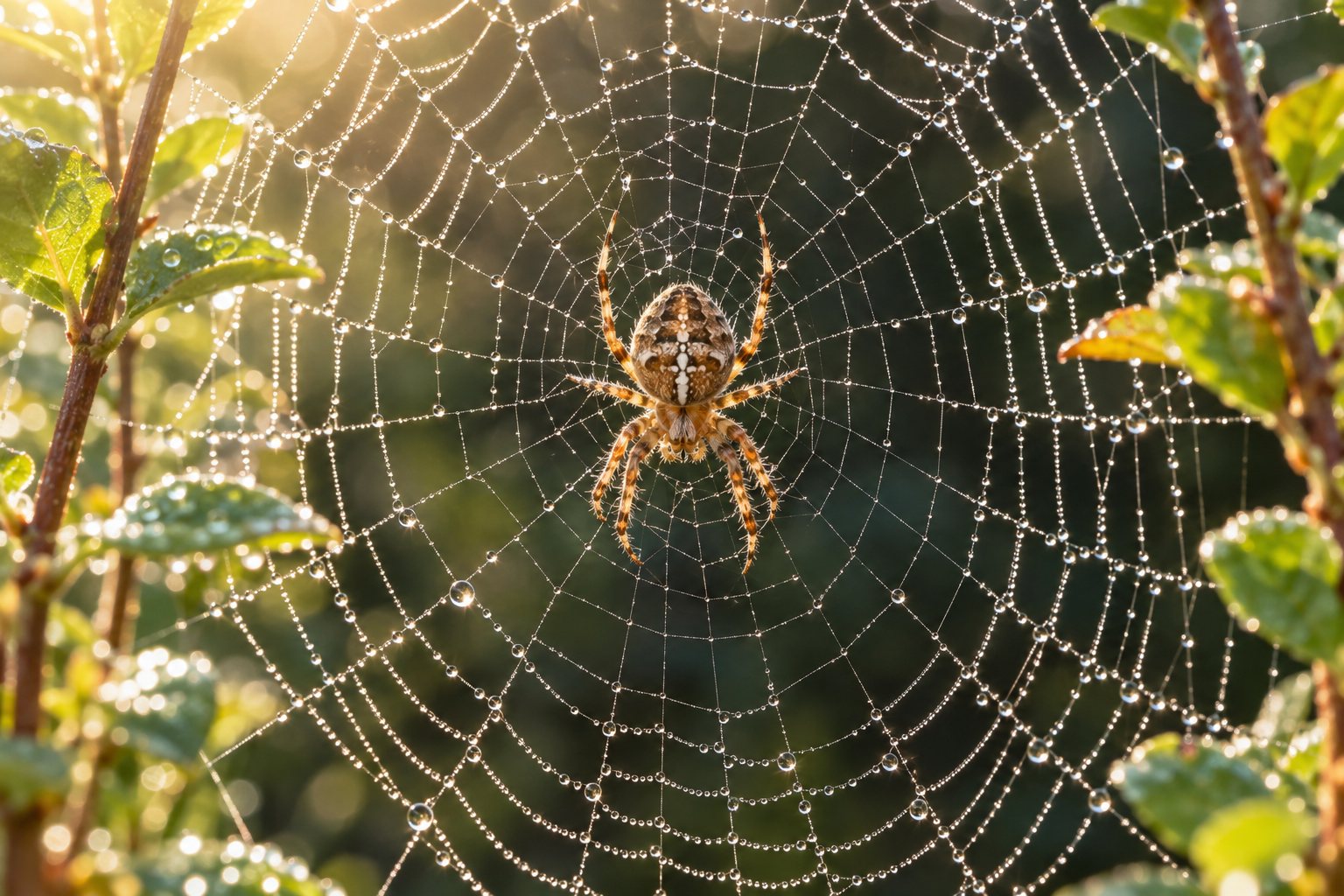
Many of the round webs you see in fall belong to orb-weavers. An orb-weaver is a spider that builds the classic wheel-shaped web, with spokes and a spiral.
The cross orbweaver (Araneus diadematus) is the same garden spider that's common across Europe. It arrived in North America from Europe and now lives across much of the northern US, especially the Pacific Northwest, the Northeast and around the Great Lakes. It's named for the pattern of white spots on its back, which often forms a cross.
Across most of the country you'll also meet the yellow garden spider (Argiope aurantia), a big black-and-yellow orb-weaver whose web has a thick zigzag of silk down the middle. Both kinds hatch in spring, spend the summer eating and growing, and by late summer and fall the females are at their biggest. A big spider builds a big web, often across a gap between bushes or a yard path, right at face height.
So there aren't suddenly more spiders. The ones that were there all summer have simply grown big enough to notice.
Their timing has a purpose, too. Adult garden spiders mate in late summer and fall, and the females lay eggs in silk sacs before the cold weather comes. The spiderlings hatch the following spring and the cycle starts again.
Reason 2: house spiders go looking for mates
Most of the big spiders that dash across the floor in fall are male house spiders on a mission. Many people think they come in from the yard to escape the cold, but that's mostly a myth. The Burke Museum in Seattle points out that house spiders usually live their whole lives indoors, and are not the same species as the spiders in your yard.
In US homes one of the most common is the common house spider (Parasteatoda tepidariorum), a small brownish spider that builds tangled cobwebs in corners and windows. In the Pacific Northwest, west of the Cascade Mountains, the giant house spider (Eratigena species, the same group found in British homes) is common too. In both, the males wander once they become adults, looking for females, and many kinds of spider do the same in late summer and fall. Those long-legged sprinters crossing the carpet are usually males on the search.
Once mating season is over, the wandering stops and you'll see far fewer of them.
How to watch a spider build its web
Watching an orb-weaver build a web is one of the best free shows in nature. Many orb-weavers make a fresh web often, even daily, usually in the evening or very early in the morning, and they often eat the old silk to reuse it. Building a new one takes an hour or less.
Find a web you walk past every day and check it at dusk or first thing in the morning, with a flashlight if it's dark. If you catch the spider building, here's what to look for:
- The bridge line. The spider lets out a thread that floats on the breeze until it catches on a twig. This is the web's top line.
- The frame. It adds threads to make an outer frame, then a Y shape in the middle.
- The spokes. It adds more threads from the center to the frame, like the spokes of a bicycle wheel.
- A temporary spiral. It walks a wide spiral outwards from the middle. This isn't sticky; it's a scaffold to walk on.
- The sticky spiral. Finally, it works its way back inwards, laying the tightly spaced sticky spiral that catches insects, and removes the scaffold as it goes.
Count the spokes. Time how long it takes. Draw the web in a nature journal. And then watch what gets caught.
Why webs look amazing on misty mornings
On cool, still fall mornings, dew forms on everything, including spider silk. The tiny water drops catch the light and suddenly you can see webs that were invisible the day before: on hedges, fences, gates and long grass. It's the best time of year for web photos. Go out early, get low with the sun behind the web, and you'll be amazed how many there are.
Why spiders are good news
It's normal to feel a bit jumpy about spiders. But they're some of the most useful animals around.
- They eat insects. A study published in 2017 estimated that the world's spiders eat 400 to 800 million metric tons of prey each year, mostly insects and springtails. That includes plenty of flies and mosquitoes.
- They're food for others. Birds, frogs, lizards and wasps all eat spiders.
- Their silk is extraordinary. It's stretchy, light and very strong for its weight, which is why scientists study it.
- A web tells you your yard is healthy. Lots of spiders means lots of insects for them to eat.
If a spider is somewhere you don't want it, you don't need to harm it. Pop a glass over it, slide a piece of stiff paper underneath and carry it outside.
Are any spiders dangerous?
Most spiders in the US are harmless to people, but two kinds are worth knowing about:
- Black widows. There are several species, and between them they live across much of the country. The females are shiny black, often with a red hourglass mark underneath. They like dark, sheltered spots such as woodpiles, sheds, garages and under outdoor furniture.
- Brown recluses. These live mainly in the south-central and Midwestern states, from roughly Nebraska and Ohio down to Texas and Georgia. They hide in quiet, dry places like boxes, closets and basements.
The rule for kids: look, but don't touch. Never put your hands where you can't see, wear gloves when moving wood or boxes, and shake out shoes and gloves that have been left in a garage or shed. If someone is bitten by a spider that might be a black widow or brown recluse, or a bite gets worse, get medical help or call Poison Control on 1-800-222-1222.
The fall spider challenge
Here's something to try this week:
- Count how many webs you can see on the way to school.
- Find one web and visit it every day for a week. Does the spider rebuild it?
- Photograph a web covered in dew.
- Draw the pattern on an orb-weaver's back in your nature journal.
We're building Scout, a nature camera for kids aged 9 to 13, shaped like an explorer's magnifying glass and worked with one thumb, launching on Kickstarter in spring 2027, and an orb-weaver is the star of the demo on our home page. When a child points Scout at something alive, their guide names it right there on the walk, using Scout's own AI chip, and back home the find becomes a Discovery Card with facts the guide reads aloud.
Spiders are at their biggest and boldest right now. Give them a proper look before winter comes.
Sources
- Natural History Museum, House spider
- Natural History Museum, Invasion of the giant spiders? Not quite
- Natural History Museum, How dangerous are false widow spiders?
- Burke Museum, Myth: Spiders come indoors in the fall
- Washington State University, Giant house spider
- Penn State Extension, Common House Spider
- iNaturalist, Cross Orbweaver (Araneus diadematus)
- National Wildlife Federation, Yellow Garden Spider
- British Arachnological Society, Orb Web Construction
- Nyffeler, M. and Birkhofer, K., An estimated 400–800 million tons of prey are annually killed by the global spider community, The Science of Nature (2017)
- Penn State Extension, Southern Black Widow Spider
- University of Kentucky Entomology, Brown Recluse Spider
- NHS inform, Types of bites and stings