Pond dipping with kids: kit, safe technique and what you'll find
For parents planning a first pond dip, or wanting to make the next one safer and more exciting. You'll get a kit list, a step-by-step technique, a spotter's table and the safety bits that matter.
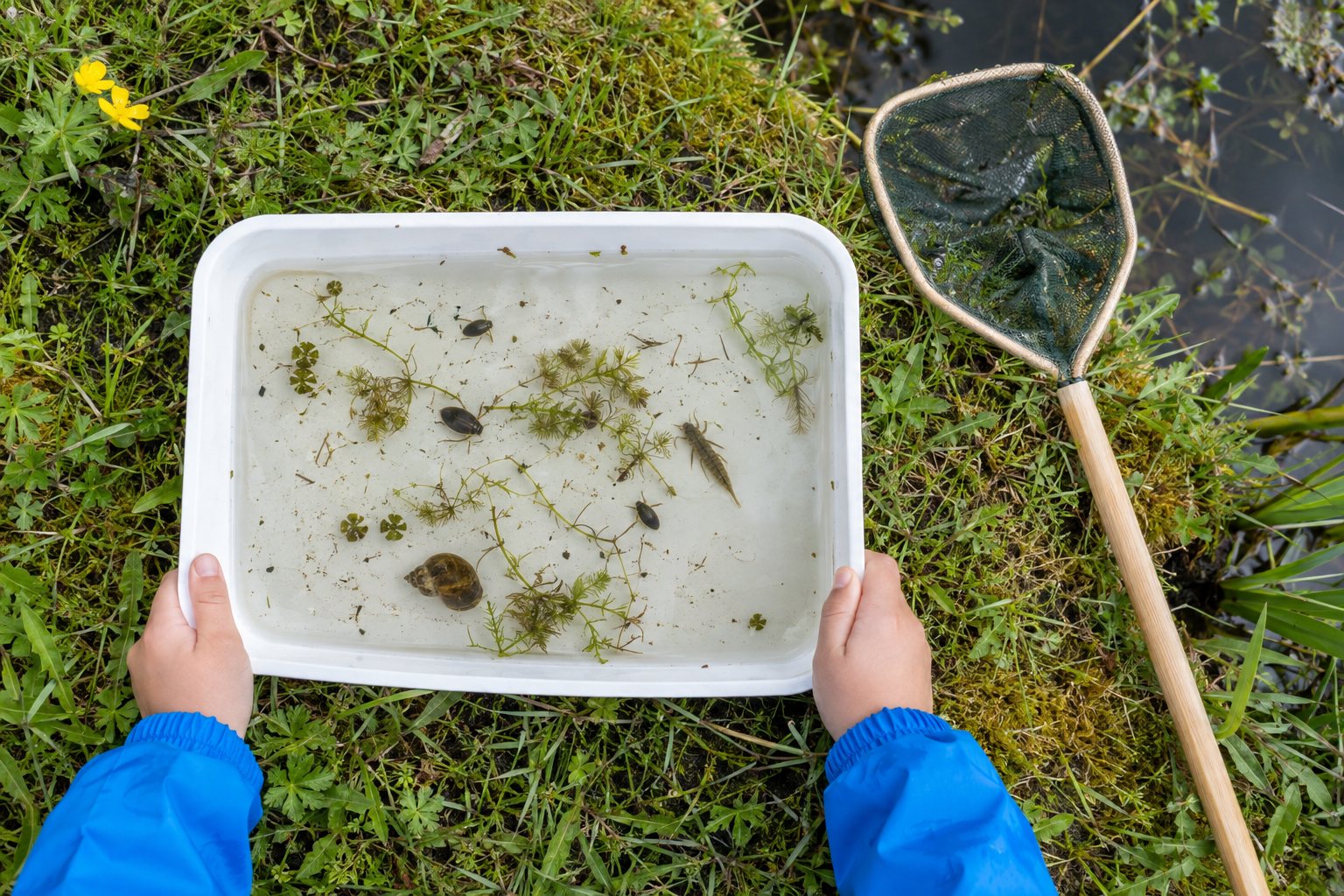
There's a moment in every pond dip when the net comes up, the water drains through, and something wriggles. Then everyone crowds round the tray and the questions start: what is it, what does it eat, why does it swim upside down?
Pond dipping with kids is one of the easiest ways to meet wildlife up close. A pond that looks empty from the bank is full of hunters, grazers and odd-looking youngsters that will one day fly. This guide covers the kit, a safe way to dip, what you might find, and how to put it all back.
What kit do you need for pond dipping?
You can spend a lot on kit, but you don't need to. The essentials:
- A pond net. A sturdy net with fine mesh and a handle long enough that nobody has to lean. Some nature reserves with dipping platforms lend them out.
- A white tray. A shallow white plastic tray or dishpan. White matters: small, dark creatures stand out against it.
- A magnifier. A hand lens, or a clear bug-viewer pot with a magnifying lid.
- A plastic spoon or small pots. For gently moving one creature at a time for a closer look, without using fingers.
- A spotter sheet. A simple identification chart, or the table further down this post.
- Rain boots, waterproof bandages, and something to clean hands with. More on why below.
How to pond dip safely
Ponds are calm and shallow-looking, which is exactly why they need respect. A few rules make all the difference.
- An adult is always there. Children should never pond dip on their own, and a grown-up should stay close to the edge the whole time.
- Choose a stable spot. A dipping platform or a firm, flat bank is best. Avoid steep, crumbly or muddy edges, and anywhere the water gets deep suddenly.
- Kneel, don't lean. Kneel or crouch on the bank and let the net's handle do the reaching. If you can't reach, move somewhere else rather than stretching.
- Cover cuts first. Put waterproof bandages over any cuts or scratches before you start.
- Hands away from faces. No nibbling snacks mid-dip, and no rubbing eyes.
- Wash hands afterwards, with soap and clean water, especially before eating.
How to pond dip, step by step
- Fill the tray first. Scoop an inch or two (a few centimeters) of pond water into your tray and put it somewhere shady and flat. Creatures should never land in a dry tray.
- Sweep in a figure of eight. Lower the net into the water near plants, where most creatures hide, and sweep it slowly in a figure-of-eight shape. This keeps what you catch in the net.
- Lift it out gently with a scooping motion, and let the water drain.
- Turn the net inside out into the tray and swish it so everything floats free.
- Watch and wait. Give the water a minute to settle. Things that looked like bits of leaf will start to move.
- Look closely. Use the spoon to move one creature at a time into a pot, then use the magnifier. Try not to handle anything with your fingers.
- Keep it cool. Keep the tray out of the sun, change the water if it warms up, and don't keep creatures for long.
What might you find in a pond?
Here are some of the regulars. Many of them are young insects, called nymphs or larvae, that live underwater before they grow wings.
| Creature | How to spot it | Did you know? |
|---|---|---|
| Water boatman | Swims the right way up, rowing with two long back legs | Mostly eats algae and bits of plants |
| Backswimmer | Swims upside down, belly to the sky | A hunter that can give a painful bite if handled, so use the spoon |
| Damselfly nymph | Slim body with three leaf-like "tails" at the end | The tails are gills it breathes through |
| Dragonfly nymph | Chunky, with no tails | Moves by squirting water out of its back end |
| Mayfly nymph | Small, usually with three thin tails, and gills flickering along its sides | Lives underwater for months, then may live only a day or so as a flying adult |
| Caddisfly larva | Lives in a tube it builds from sand, twigs or tiny shells | Each one builds its own case, like a portable house |
| Pond snail | Spiral shell, gliding over the tray or up the sides | Grazes on algae |
| Water strider | Stands on top of the water rather than in it | Water-repelling hairs on its legs let it walk on the surface |
In the UK, people often call backswimmers "greater water boatmen", which can be confusing. The quick test is which way up it swims.
Tadpoles, salamanders and crayfish (US)
Depending on where you live, you may find:
- Tadpoles of frogs and toads, from spring into summer.
- Salamanders and newts, such as the eastern newt. Amphibians breathe partly through their skin, so they're best left in the water. If one must be moved, use wet hands with no sunscreen or bug spray on them.
- Crayfish, which can give a sharp pinch. Leave them in the tray, or let an adult lift one gently from behind its claws.
- Snapping turtles. If you see one, keep well back and never try to catch or touch it. They can bite hard.
Many parks and preserves have their own rules about catching and handling wildlife, so check before you dip, and don't take anything home.
Putting everything back
The last step is the most important one.
- Return creatures where you found them. Lower the tray to the water's edge and gently tip everything back in, rather than pouring from a height.
- Rinse the net in the same pond so nothing is left stranded in it.
- Don't move anything between ponds. Water, plants and animals from one pond can carry diseases and unwanted species to another.
- Leave the bank as you found it, and take your trash home.
Ready to dip
You don't need a huge lake. A well-kept village pond, a nature reserve dipping platform or a school pond can be full of life. Go on a warm day between spring and early fall, when ponds are at their busiest, and let the kids be the ones to turn the net out.
If you're wondering what we're up to: we're building Scout, a nature camera for kids aged 9 to 13, shaped like an explorer's magnifying glass and worked with one thumb, launching on Kickstarter in spring 2027. When a child points it at something alive, their guide names it right there on the walk, using Scout's own AI chip, and back home every new find becomes a Discovery Card in their collection. Pond creatures make brilliant cards.
Happy dipping, and don't forget to wash those hands.