12 nature walk games for kids that 9 to 13 year olds actually enjoy
For parents of 9 to 13 year olds who hear "how much further?" ten minutes into every walk. You'll get twelve games that need almost no kit, each with a twist for older kids.
The right nature walk games for kids can turn "how much further?" into "wait, one more minute". The trouble is that most lists are written for five year olds. Nine to thirteen year olds want a challenge, a bit of competition and something that doesn't feel babyish.
So here are twelve games that work for that age. Each one needs little or no kit, takes five to twenty minutes, and comes with a twist that makes it harder for older kids. Pick two or three per walk rather than trying them all.
What you might want to bring
None of this is essential, but a small bag with these covers every game below:
- a length of string, about 3 feet long (or a hula hoop)
- a few crayons and some plain paper
- a notebook and pencil each
- a phone or camera
- a hand lens or magnifying glass
- a scarf for a blindfold
- a handful of paint sample cards from a hardware store
1. Paint chip color match
Give each player two or three paint sample strips. The challenge is to find something in nature that matches each shade exactly. Hold the card right up against it to check.
Twist for older kids: Pick five greens that look nearly the same and find all five. It's much harder than it sounds, and it trains the eye to notice how many greens a single hedge or bush holds.
2. Sound map
Everyone sits down, a little apart, and draws an X in the middle of a page. That X is you. For five minutes, with eyes mostly closed, mark every sound you hear on the page in the direction it came from: a squiggle for birdsong, a line for wind, a box for a car.
Twist for older kids: Split the sounds into three groups: animal, weather and human. Which group wins? Try again somewhere quieter and compare.
3. I spy by sound
A quick game for walking along. Instead of "something beginning with…", the spotter says "I hear something…" and gives a clue: "high and repeating", "rustling low down", "far away and buzzing". Everyone else points to where they think it is.
Twist for older kids: No pointing until you can say what made it. A bird, a bee, leaves, water, a woodpecker tapping.
4. Micro-safari
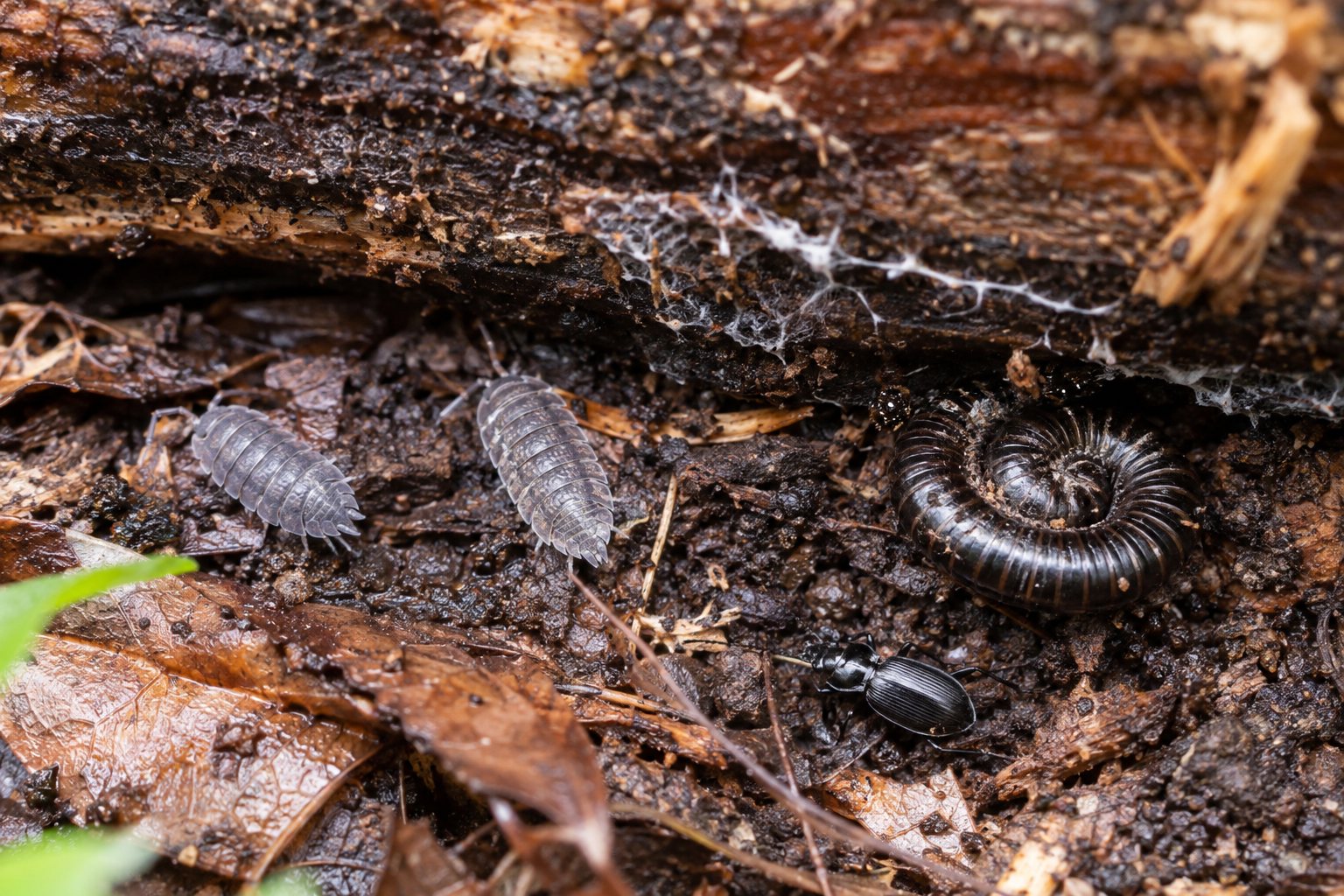
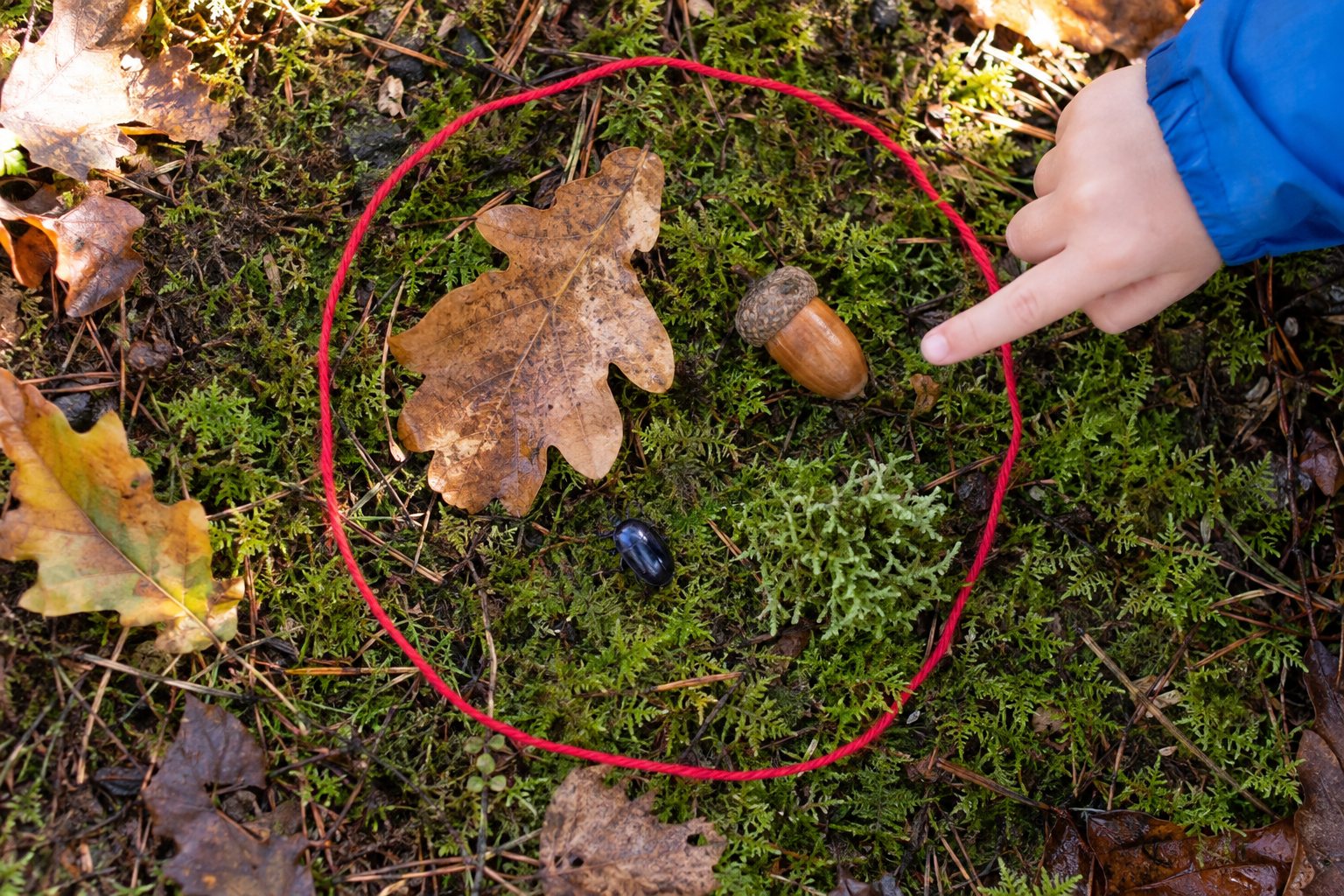
Lay a loop of string or a hula hoop on the ground. That's your safari park. Kneel down with a hand lens and count every living thing inside it: beetles, woodlice, ants, spiders, moss, lichen, tiny seedlings.
Twist for older kids: Make it an experiment. Put one loop somewhere sunny and one somewhere shady, or one on a lawn and one under a hedge. Which has more kinds of life? Why might that be? That's real ecology, the science of how living things fit together.
Put back any log or stone you lift, gently, exactly how you found it.
5. Bark rubbing
Hold a sheet of paper against a tree trunk and rub the side of a crayon across it. The bark's pattern appears like magic. Do three or four different trees.
Twist for older kids: Swap rubbings with a partner without saying which tree each came from. They have to find the matching trees. Birch, oak and pine are very different; two oaks are a real test.
6. Sit spot
Each person finds a spot on their own, within sight of a grown-up, and sits still and silent for five minutes. At first nothing happens. Then birds that flew off come back, insects carry on, and a squirrel might appear. The world forgets you're there.
Twist for older kids: Stretch it to ten minutes and write down three things you noticed that you'd never have seen while walking. Go back to the same spot each season and see what has changed.
7. Camera challenge
Give everyone a list of photos to take. Good ones for this age:
- something smaller than your fingernail
- a pattern that repeats
- two colors that clash
- something that has been nibbled
- a shadow that looks like something else
- the oldest-looking thing you can find
Twist for older kids: Take a super close-up of something so it's hard to recognize, then challenge the others to guess what it is. Winner picks the next game.
8. Nature bingo
Draw a four by four grid and fill each square with something you're likely to see: a feather, a mushroom, a bird on a wire, a spider's web, a seed, a puddle, something red. First to get a line shouts "bingo".
Twist for older kids: Let them make the cards for the grown-ups, and make them tricky. Squares like "a leaf with exactly five points" or "an insect with no wings" keep everyone looking harder.
9. Leaf ID race
Each player collects one fallen leaf of every shape they can find in ten minutes: long and thin, round, lobed like a hand, with jagged teeth, in several small leaflets. Lay them out in a row.
Twist for older kids: Now try to name the tree each one came from, using a simple tree guide or by finding the tree it fell from. A point for every correct name.
10. Meet a tree
This one comes from Joseph Cornell's classic book Sharing Nature with Children. Work in pairs. One person is blindfolded. The other leads them carefully, by the hand, to a tree nearby. The blindfolded player explores it with their hands: the bark, any moss, how wide it is, whether there are low branches. Then they're led back, a different way, and the blindfold comes off. Can they find their tree?
Twist for older kids: Lead them further, with a few turns, before the blindfold comes off. Choose flat, clear ground, and the guide's job is to keep them safe.
11. Follow my trail
One team goes ahead and leaves arrows made from sticks, pine cones or stones at every junction. The other team follows a few minutes later.
Twist for older kids: Add signs of your own, like a cross of sticks for "not this way" or three stones for "hidden message here". The last team to walk the trail tidies up the markers, so the path is left as you found it.
12. Spot the odd one out
Before the kids arrive, a grown-up places ten small human-made things along a short stretch of path: a peg, a coin, a button, a bottle top, a hair tie. Some are bright, some are in colors that blend in. Walk the stretch slowly. How many can you spot?
Twist for older kids: Use only green and brown objects. It's a quick way to understand camouflage, and why a moth on bark or a caterpillar on a twig is so hard to see. Collect every object afterwards.
Keeping it safe and kind
- Stay in sight or earshot, especially for the sit spot and the trail game.
- Blindfold games need flat, clear ground and a responsible guide.
- Look, don't pick. Fallen leaves and cones are fine to collect. Growing plants and flowers stay put.
- Never touch or taste wild fungi or berries.
- Check for ticks after long grass or undergrowth.
- Leave it as you found it. Leave No Trace's rule of "leave what you find" covers it.
Making it stick
The games that work best are the ones kids can win. Keep score if they like scoring, and let them choose the next game. Nine to thirteen year olds are also brilliant at running games for younger siblings or cousins. Put them in charge and they'll often try harder than when they're just playing.
Most of all, don't rush. A walk where you only get halfway round because everyone was lying on their stomachs watching ants is a good walk.
Sources
- Joseph Bharat Cornell, Sharing Nature with Children (first published 1979)
- GOV.UK, The Countryside Code
- Leave No Trace, Principle 4: Leave What You Find