How to identify trees by their leaves: a simple guide for kids
For families who'd like to put names to the trees on their walks. You'll learn the six leaf clues that narrow things down fast, see the common trees where you live, and get a leaf detective game to play.
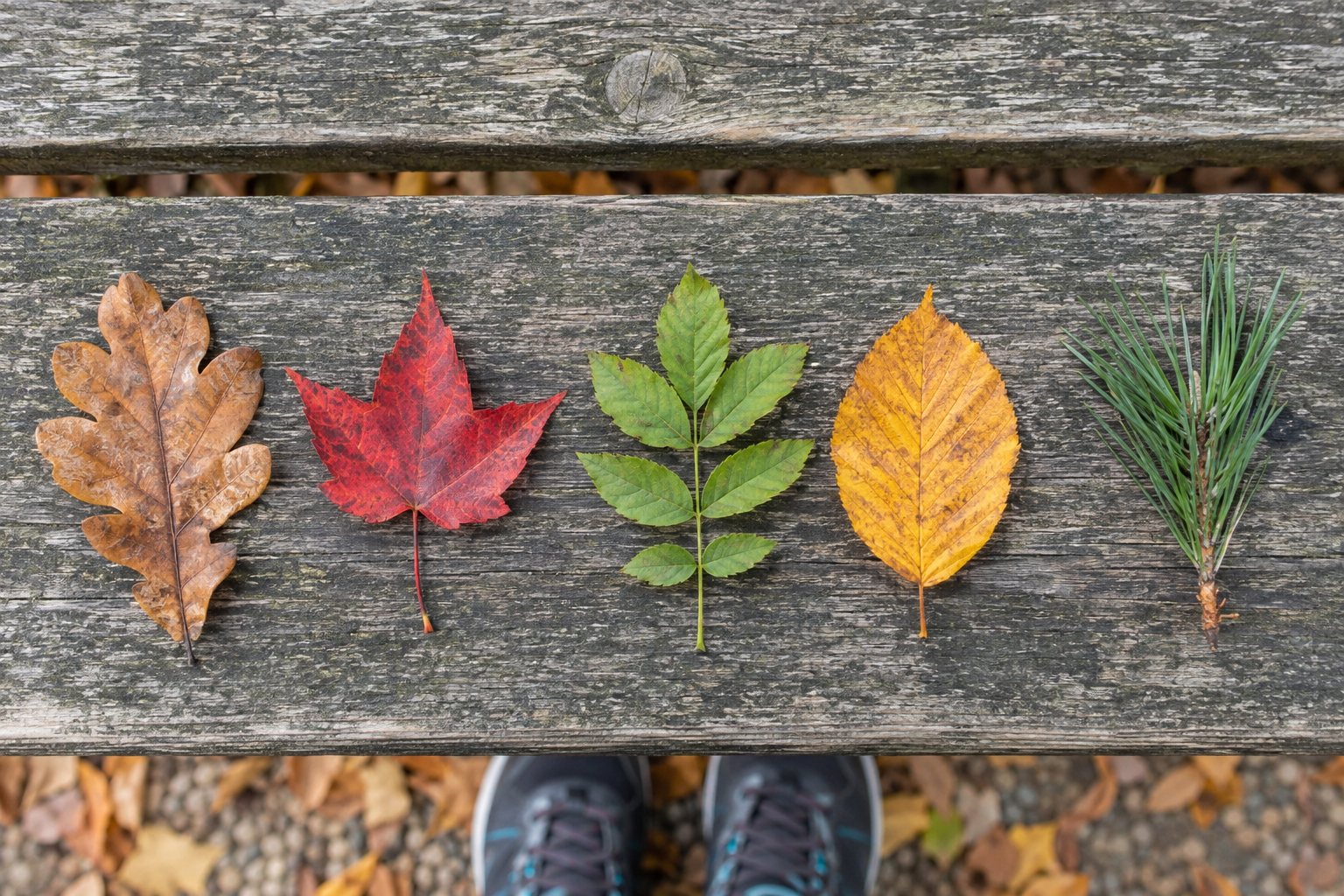
Learning how to identify trees by their leaves is like learning to read a secret code. Once you know what to look for, a walk in the park turns into a string of "that's an oak… that's a maple… hang on, what's that one?"
You don't need to memorize hundreds of trees. You need about six clues. This guide explains each one in plain words, gives you a table of common trees where you live, and ends with a leaf detective game to try on your next walk.
The six leaf clues
Look at a leaf and ask these questions, roughly in this order. Each answer rules out lots of trees.
1. Needles or broad leaves?
Needles are thin and narrow, like pine, spruce and fir. Scales are tiny and overlapping, like cypress and many junipers. Most trees with needles or scales are evergreen, which means they keep their leaves all winter. (Larch is the famous exception: its needles turn yellow and fall off.)
Broadleaves are flat and wide, like oak, maple and beech. Most broadleaved trees in the UK and the US are deciduous, which means they drop their leaves in the fall. Holly is a well-known evergreen exception.
For pines, count how many needles grow together in each little bundle. It's a real clue: some pines have them in twos, some in threes, some in fives.
2. Simple or compound?
This is the clue that trips people up.
- A simple leaf is one single blade on its stalk. Oak, beech and maple leaves are simple.
- A compound leaf is split into several smaller leaflets on one stalk. It can look like a whole twig of leaves, but it's really one leaf.
The test: find the bud. There's a bud where a whole leaf joins the twig, but no bud at the base of each leaflet.
Compound leaves come in two shapes:
- Feather-shaped (pinnate): leaflets in pairs along a central stalk, like ash or rowan.
- Hand-shaped (palmate): leaflets spread from one point, like fingers, as in horse chestnut.
3. Lobed or not?
A lobed leaf has deep bumps or points around its edge, with gaps in between, like an oak or a maple. The shape of the lobes matters:
- Rounded lobes, like fingertips.
- Pointed lobes, sometimes with a tiny bristle at the tip.
4. What's the edge like?
Run a finger gently round the edge.
- Smooth edge: no teeth at all.
- Toothed edge: little saw-like points. Some leaves have small teeth on bigger teeth, called double-toothed.
- Wavy edge: gently rippled, with no sharp points.
- Spiny edge: sharp prickles, like holly. Careful!
5. Opposite or alternate?
Look at how the leaves (or the buds, in winter) are arranged on the twig.
- Opposite: leaves grow in pairs, directly across from each other.
- Alternate: leaves take turns, one on this side, then one a bit further up on the other side, in a zigzag.
This clue is powerful because only a few kinds of tree have opposite leaves. American foresters remember them with the word MAD Cap Horse: Maple, Ash, Dogwood, Caprifoliaceae (the honeysuckle family) and Horse chestnut, including buckeyes. If the leaves are opposite, you've already narrowed it down to a handful.
6. Size, texture and extra clues
Is the leaf shiny or dull? Hairy underneath? Does the stalk look red? Is there fruit nearby: acorns, winged "helicopter" seeds, nuts, berries or spiky cases? Fruit and seeds are some of the best clues of all, especially in fall when the ground is covered in them.
Common trees and how to recognize their leaves
These trees are common across much of the eastern and central US. (Out West, the list changes: look for quaking aspen, bigleaf maple, Douglas fir and ponderosa pine.)
| Tree | Leaf type | Shape and edge | Arrangement | Extra clue |
|---|---|---|---|---|
| Red maple | Simple | 3 main lobes, toothed edge, V-shaped gaps | Opposite | Red stalks and twigs; bright red in fall |
| Sugar maple | Simple | 5 lobes, smooth edges, U-shaped gaps | Opposite | Brilliant orange and yellow in fall |
| Northern red oak | Simple | Pointed lobes with bristle tips | Alternate | Big acorns with a flat, shallow cap |
| White oak | Simple | Rounded lobes, no bristles | Alternate | Acorns with a bumpy, bowl-shaped cap |
| White ash | Compound (feather-shaped) | 5 to 9 leaflets | Opposite | Single-winged seeds in bunches |
| Tulip tree | Simple | Four lobes with a squared-off tip, like a tulip | Alternate | Tulip-like green and orange flowers in spring |
| Sweetgum | Simple | Star-shaped, 5 to 7 pointed lobes | Alternate | Spiky "gumball" seed balls |
| American beech | Simple | Oval, toothed, straight veins that each end in a tooth | Alternate | Smooth gray bark; papery leaves often hang on all winter |
| Eastern white pine | Needles | Soft needles in bundles of 5 | Bundles along the twig | Long, slightly curved cones |
A maple memory trick: there's a U in "sugar", and sugar maple leaves have U-shaped gaps between the lobes. Red maple gaps are V-shaped. Red maple is one of the most common trees in the eastern US, so it's a good one to learn first.
Maple or sweetgum? Both have star-like leaves. But maple leaves are opposite and sweetgum leaves are alternate. That one clue settles it.
Ash trees need our help. An insect from Asia called the emerald ash borer has killed huge numbers of ash trees across the US. If you see an ash with a thinning top, that may be why.
The leaf detective game
This is a great activity for a walk, and it works best in fall when there are plenty of fallen leaves.
You'll need: a bag, a notebook and pencil, and a tree guide or this page.
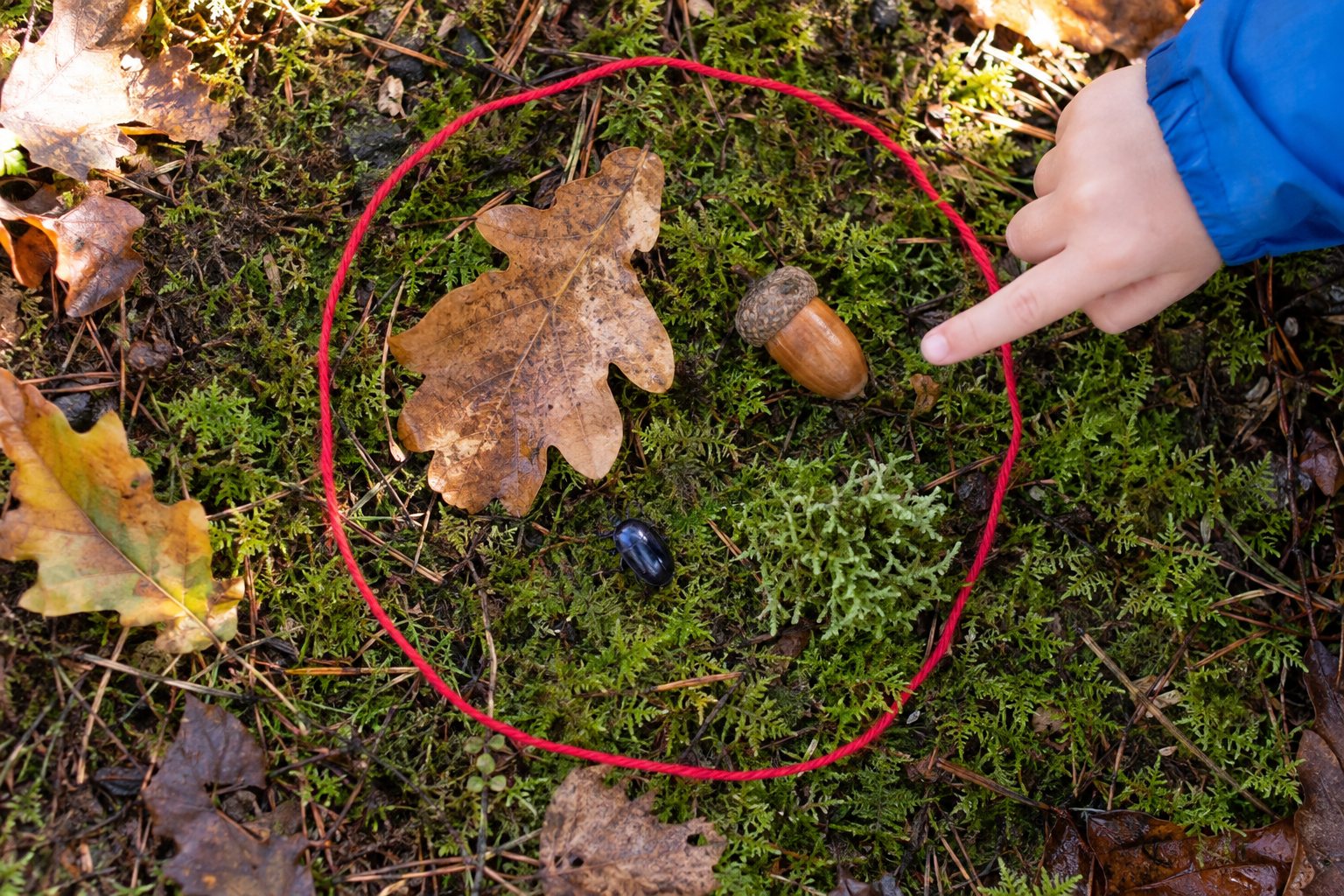
- Collect. Each detective gathers five fallen leaves that all look different. Only take leaves from the ground.
- Sort. Lay them out and sort them using the clues, one question at a time: Needles or broad? Simple or compound? Lobed or not? Smooth or toothed edge?
- Make a key. Draw a tree diagram in your notebook, starting with the first question and splitting into two branches each time, until every leaf has its own spot. Scientists call this an identification key. You've just made your own.
- Find the tree. Look up to find the tree each leaf fell from. Check whether its leaves are opposite or alternate while they're still on the twig (look, don't snap it off).
- Name it. Use the table above to name each one. One point for each correct name, and a bonus point for anyone who can find the tree's fruit or seeds nearby.
Level up: Swap your key with someone else. Can they use it to name your leaves without any help?
Keep them: Press your best leaves between sheets of paper inside a heavy book for a week or two, then stick them in a nature journal with the tree's name, the date and where you found it.
A few safety reminders
- Don't eat anything you find on a tree, including berries, nuts and seeds, unless a grown-up who really knows has checked it. Holly berries and buckeyes are poisonous.
- Wash your hands after handling leaves and seeds, especially before snacks.
- Collect only fallen leaves, and never break branches.
- Check for ticks if you've been in long grass or undergrowth.
Wrapping up
Start with the trees near your home. Learn one a week, and within a couple of months you'll know the main trees on your street and in your local park. The best part is that it lasts: once you've learned to spot an oak or a maple, you'll never stop seeing them.
Sources
- The Woodland Trust, How to identify trees
- The Woodland Trust, Ash (Fraxinus excelsior)
- The Woodland Trust, Sycamore (Acer pseudoplatanus)
- The Woodland Trust, Horse chestnut (Aesculus hippocastanum)
- Virginia Tech Dendrology, Leaf arrangement
- University of New Hampshire Extension, Red or Sugar Maple? How do you tell the difference?
- US Forest Service, Red Maple, Silvics of North America
- Virginia Tech Dendrology, American beech fact sheet