Mushroom hunting with kids: where to look, what to notice, how to stay safe
For parents of curious 9 to 13-year-olds who want a safe, easy fall outing. You'll get the rules to agree at the door, where to look, what to notice and some easy mushrooms to find near you.
Fall is when the woods sprout. Overnight, after a good soaking of rain, logs grow frilly brackets, lawns grow rings of little caps and tree stumps turn orange. Mushroom hunting with kids is one of the best treasure hunts there is: free, a little bit spooky, and full of shapes you've walked past a hundred times without seeing.
This guide gives you the rules to agree before you go, where and when to look, what to notice, some easy mushrooms to find near you, and a spore print you can make safely at the kitchen table.
The rules to agree before you go
Looking at mushrooms is safe. The danger is in eating them, so agree these at the door:
- Look and photograph. Don't pick, don't touch. Leave every mushroom where you found it. What you see is only the "fruit" of a much bigger living thing under the ground, and the next family deserves to find it too.
- Never eat a wild mushroom. Not a nibble, not a lick, not "just to see". Some of the deadliest look plain and ordinary (more on that below).
- No app, book or camera can tell you a mushroom is safe to eat. Experts get it wrong. Treat every wild one as poisonous.
- Wash hands when you get home, before any snacks. You'll have touched logs, leaves and soil even if you kept your hands off the fungi.
- Keep dogs close and younger brothers and sisters closer. Some fungi are poisonous to pets too.
- If anyone does eat one, act straight away. Don't wait for symptoms. Call Poison Help on 1-800-222-1222 (free, 24 hours a day), or 911 if they're unwell. Take a photo of the mushroom, or put what's left of it in a paper bag, so experts can work out what it was.
Why some deadly mushrooms look so ordinary
The mushrooms that cause the most harm aren't the spotty red ones from storybooks. They're pale and plain.
The death cap has a smooth cap that can be olive-green, yellowish or almost white. It came from Europe and has spread in parts of North America, especially California. Destroying angels are pure white and grow in woods across much of the country. Both look like the sort of mushroom you'd buy at the grocery store.
They belong to a group called Amanita, and they hide their clues: white gills, a skirt-like ring on the stem, and a cup-shaped bag at the base that is often buried in the soil. Worse, symptoms of poisoning can take 6 to 24 hours to appear, by which time serious damage may already be done. A young Amanita can even look like a small, harmless puffball before it opens.
That's why "it looks just like the picture" is never good enough, and why rule 2 has no exceptions.
When and where to look
When. In much of the US, late summer through fall is the main season. Along the West Coast, many mushrooms follow the rains instead, from fall into winter and even early spring. The best time of all is a few days after heavy rain. Some tough bracket fungi and jelly fungi can be found all year.
Where. Fungi feed on dead things or partner with living trees, so look:
- on rotting logs, stumps and fallen branches;
- among the leaf litter on the woodland floor;
- under particular trees, such as birch and pine;
- on the trunks of living and dead trees, where brackets grow like shelves;
- on lawns and in parks, sometimes in a circle called a fairy ring.
What to bring. A phone or camera, a small mirror (hold it under a cap to see what's underneath without picking it), a magnifying glass, a coin or ruler to put beside the mushroom for scale in your photo, and a notebook.
What to notice: a mushroom detective's checklist
Naming a mushroom is hard, even for experts. Noticing is easy, and it's where the fun is. Pick one mushroom and work down this list together:
| Clue | What to look for |
|---|---|
| Where it's growing | On wood, soil or grass? Under which tree? Many fungi only ever grow with one kind of tree. |
| The cap | Color, size, shape (dome, flat, funnel, shelf). Is it shiny, scaly, sticky-looking or spotty? |
| Underneath | Use your mirror. Gills are thin blades, like the pages of a book. Pores are tiny holes, like a sponge. Some have little teeth or spines instead. |
| The stem | Is there a stem at all? Is there a ring or skirt around it? |
| The base | Can you see a cup or bag around the bottom? Don't dig to find out. |
| Friends and neighbors | Are there lots in a cluster, a line or a ring? Are there nibble marks from slugs? |
A good photo shows the cap from above, the underneath (with the mirror), the stem from the side and the place it's growing. Put your coin in one shot for size.
Easy mushrooms to spot near you
These are common, eye-catching and fairly easy to recognize. Remember: recognizing is for fun, never for eating.
- Fly agaric. In the Northeast and upper Midwest, look for the American yellow fly agaric: a yellow to orange cap, often redder in the middle, dotted with cream warts. In the West, the fly agaric is red with pale yellowish warts. It is poisonous, so look and photograph only.
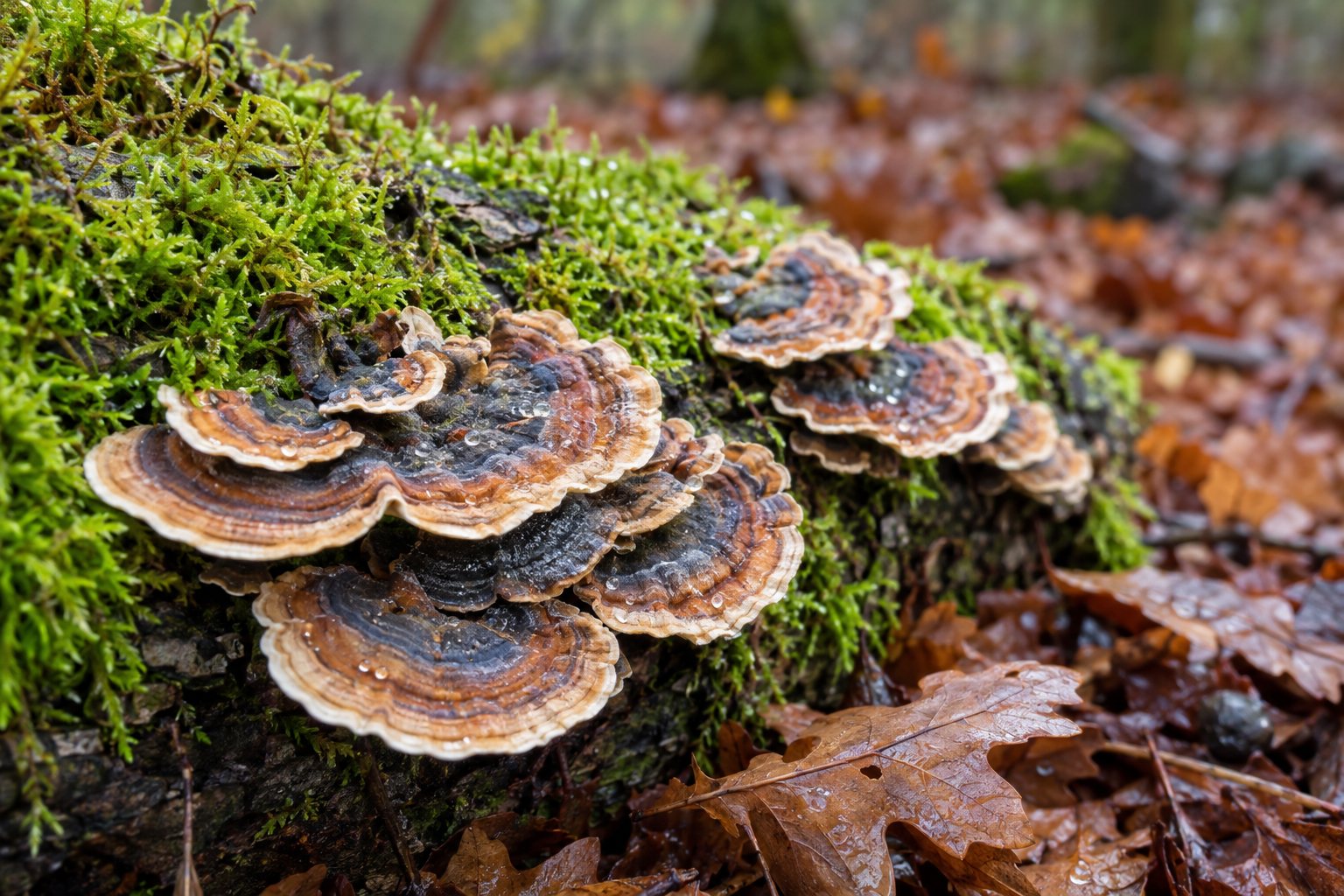
- Turkey tail. Thin, wavy brackets striped in browns, tans and blue-grays, stacked up on dead wood. Check underneath with your mirror: tiny pores, not gills.
- Chicken of the woods. Bright orange-and-yellow shelves on trees and stumps, from summer into fall. You'll spot it from across the woods.
- Puffballs. Round white or brown balls on lawns and woodland floors. When an old one is hit by a raindrop, it puffs out a cloud of brown spores. (A young, deadly Amanita can look like a small puffball, which is one more reason to leave them all alone.)
- Jack-o'-lantern. Bright orange clumps at the base of hardwood trees, or on buried roots, in the East from summer into fall. It's poisonous, and in total darkness its gills can glow a faint green.
Try this at home: a spore print (the safe way)
Under a mushroom's cap, the gills drop spores: specks far too small to see one at a time, which do the job that seeds do for plants. You can catch them in a picture, and you don't need a wild mushroom at all. Use one from the grocery store.
- Buy a mushroom with an open cap and dark gills, such as a big flat or portobello mushroom.
- A grown-up cuts off the stem, close to the cap.
- Lay the cap gills-down on paper. Half white, half black is best, so any color of spore shows up.
- Cover it with a bowl or glass so no draft blows the spores away.
- Leave it overnight, then lift the bowl and the cap very gently.
You should find a brown print that copies the pattern of the gills, like a starburst. Experts use the color of a spore print as one clue to a mushroom's identity. Throw the mushroom away afterwards, and wash hands.
Taking it further
This is exactly the kind of walk we're building Scout for. Scout is a nature camera for kids aged 9 to 13, shaped like an explorer's magnifying glass and worked with one thumb, launching on Kickstarter in spring 2027: when a child points it at a mushroom, their guide names it right there on the walk, using Scout's own AI chip, and it would rather say "I'm not sure" than tell them something wrong. But a name is never permission to eat: no camera or app, Scout included, can tell you a mushroom is safe.
Happy hunting
Mushrooms don't wait around. The ring on the lawn this weekend may be gone by next, so go soon, go after rain, and go slowly. Agree the rules, bring a mirror and a camera, and see how many different shapes you can find. The best finds are the ones you leave exactly where they are.
Sources
- Poison Control (National Capital Poison Center): Mushroom poisoning
- California Department of Public Health: Poisonous mushrooms
- Wild Food UK: Identifying Amanitas
- NatureSpot: Identify 100 common fungi (PDF)
- Woodland Trust: King Alfred's cakes
- MushroomExpert.com: Amanita muscaria var. guessowii
- MushroomExpert.com: Amanita muscaria var. flavivolvata
- First Nature: Jack-o'-lantern (Omphalotus illudens)
- North American Mycological Association: How to make a spore print